
Join Our JEE Preparation Group
Prep with like-minded aspirants; Get access to free daily tests and study material.
Sign in
Please select an account to continue using cracku.in
↓ →
Join Our JEE Preparation Group
Prep with like-minded aspirants; Get access to free daily tests and study material.
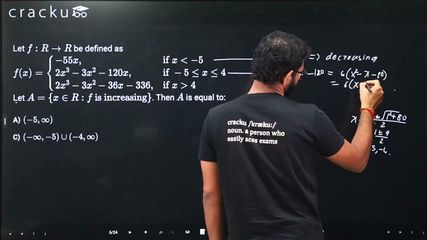
Let $$f : R \to R$$ be defined as
$$f(x) = \begin{cases} -55x, & \text{if } x < -5 \\ 2x^3 - 3x^2 - 120x, & \text{if } -5 \leq x \leq 4 \\ 2x^3 - 3x^2 - 36x - 336, & \text{if } x > 4 \end{cases}$$
Let $$A = \{x \in R : f \text{ is increasing}\}$$. Then $$A$$ is equal to:
We need to find the set $$A = \{x \in R : f \text{ is increasing}\}$$ for the piecewise function.
For $$x < -5$$: $$f(x) = -55x$$, so $$f'(x) = -55 < 0$$. The function is decreasing in this interval.
For $$-5 \leq x \leq 4$$: $$f(x) = 2x^3 - 3x^2 - 120x$$, so $$f'(x) = 6x^2 - 6x - 120 = 6(x^2 - x - 20) = 6(x - 5)(x + 4)$$. This is positive when $$x < -4$$ or $$x > 5$$. Within $$[-5, 4]$$, the derivative is positive for $$-5 \leq x < -4$$ and negative for $$-4 < x \leq 4$$.
For $$x > 4$$: $$f(x) = 2x^3 - 3x^2 - 36x - 336$$, so $$f'(x) = 6x^2 - 6x - 36 = 6(x^2 - x - 6) = 6(x - 3)(x + 2)$$. This is positive when $$x > 3$$ or $$x < -2$$. Since $$x > 4$$, the derivative is positive for all $$x > 4$$.
We verify continuity at $$x = -5$$: from the left, $$f(-5) = -55(-5) = 275$$; from the middle piece, $$f(-5) = 2(-125) - 3(25) - 120(-5) = -250 - 75 + 600 = 275$$. At $$x = 4$$: from the middle piece, $$f(4) = 2(64) - 3(16) - 120(4) = 128 - 48 - 480 = -400$$; from the right piece, $$f(4) = 128 - 48 - 144 - 336 = -400$$. Both match, confirming continuity.
Combining, $$f$$ is increasing on $$(-5, -4)$$ and $$(4, \infty)$$.
Therefore, $$A = (-5, -4) \cup (4, \infty)$$.
Was this solution helpful?
Click on the Email ☝️ to Watch the Video Solution
Create a FREE account and get:
_1.webp)

Educational materials for JEE preparation

Ask our AI anything

AI can make mistakes. Please verify important information.
AI can make mistakes. Please verify important information.


