
Join Our JEE Preparation Group
Prep with like-minded aspirants; Get access to free daily tests and study material.
Sign in
Please select an account to continue using cracku.in
↓ →
Join Our JEE Preparation Group
Prep with like-minded aspirants; Get access to free daily tests and study material.
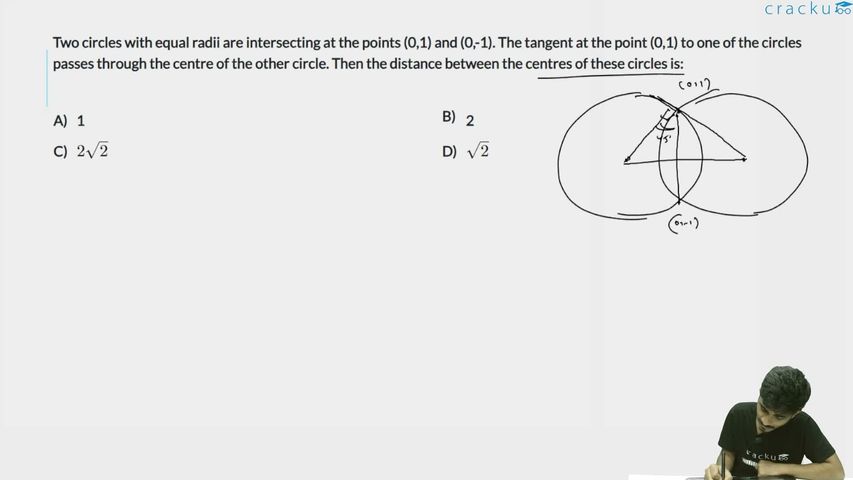
Two circles with equal radii are intersecting at the points (0,1) and (0,-1). The tangent at the point (0,1) to one of the circles passes through the centre of the other circle. Then the distance between the centres of these circles is:
Let the two required circles be
$$S_1:(x-a)^2+y^2=r^2\qquad\text{and}\qquad S_2:(x-c)^2+y^2=r^2,$$
where $$r$$ is their common radius, and the centres are $$C_1(a,0)$$ and $$C_2(c,0)$$ to be found. Both circles pass through the two common points $$(0,1)$$ and $$(0,-1).$$
We first use the fact that a point $$(x_1,y_1)$$ lies on a circle centred at $$(h,k)$$ with radius $$r$$ iff
$$ (x_1-h)^2+(y_1-k)^2=r^2. $$
Applying this to $$S_1$$ with the point $$(0,1)$$ gives
$$ (0-a)^2+(1-0)^2=r^2\;\Longrightarrow\;a^2+1=r^2. \quad -(1)$$
Similarly, substituting $$(0,-1)$$ in $$S_1$$ gives
$$ (0-a)^2+(-1-0)^2=r^2\;\Longrightarrow\;a^2+1=r^2. \quad -(2)$$
Equations (1) and (2) are identical, so no new condition arises; however, notice that they force the y-coordinate of the centre to be $$0$$, confirming our choice $$C_1(a,0).$$ Repeating the same calculation for $$S_2$$ shows that its centre must also lie on the x-axis, so we may safely write it as $$C_2(c,0).$$
Next, we translate the given geometric condition into an equation. We are told that “the tangent at the point $$(0,1)$$ to one of the circles passes through the centre of the other circle.” Take the tangent to $$S_1$$ at $$(0,1).$$
The vector from $$C_1(a,0)$$ to $$(0,1)$$ is $$(-a,\,1),$$ so the slope of the radius $$C_1P$$ is
$$m_{\text{radius}}=\frac{1}{-a}=-\frac1a.$$
For a line perpendicular to this radius (i.e. the tangent), the product of slopes must be $$-1,$$ hence
$$m_{\text{tangent}}\;=\;a.$$
The tangent passes through $$(0,1),$$ so by the point-slope form we have
$$ y-1 = a(x-0)\;\Longrightarrow\;y=ax+1. \quad -(3)$$
This tangent must pass through the centre $$C_2(c,0).$$ Substituting $$(x,y)=(c,0)$$ into (3) we get
$$ 0 = ac + 1\;\Longrightarrow\;c=-\frac1a. \quad -(4)$$
Because the radii of the two circles are equal, we set their squared radii equal using (1):
$$ a^2 + 1\;=\;r^2\;=\;c^2 + 1. $$
Cancelling the 1’s on both sides gives
$$ a^2 = c^2. \quad -(5)$$
Now substitute the value of $$c$$ from (4) into (5):
$$ a^2 = \left(-\frac1a\right)^2 = \frac1{a^2}. $$
Multiplying by $$a^2$$ on both sides yields
$$ a^4 = 1\;\Longrightarrow\;a^2 = 1\;\Longrightarrow\;a = \pm1. $$
Using (4) we correspondingly get
$$ c = -\frac1a = \begin{cases} -1 & \text{if } a=1,\\[6pt] \;1 & \text{if } a=-1. \end{cases} $$
Thus in either case the two centres are $$C_1(1,0)$$ and $$C_2(-1,0)$$ or vice-versa. The distance $$d$$ between them is
$$ d = |a-c| = \bigl|\,a - \bigl(-\tfrac1a\bigr)\bigr| = |\,a + \tfrac1a\,|. $$
For $$a = \pm1,$$ this becomes
$$ d = |\,\pm1 + \tfrac1{\pm1}\,| = |\,\pm1 \pm 1\,| = 2. $$
Hence, the correct answer is Option B.
Was this solution helpful?
Click on the Email ☝️ to Watch the Video Solution
Create a FREE account and get:
_1.webp)

Educational materials for JEE preparation

Ask our AI anything

AI can make mistakes. Please verify important information.
AI can make mistakes. Please verify important information.
