
Join Our JEE Preparation Group
Prep with like-minded aspirants; Get access to free daily tests and study material.
Sign in
Please select an account to continue using cracku.in
↓ →
Join Our JEE Preparation Group
Prep with like-minded aspirants; Get access to free daily tests and study material.
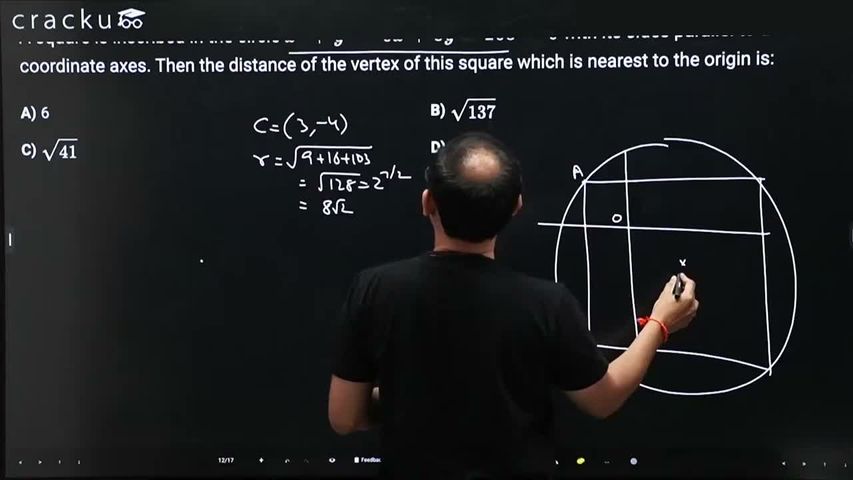
A square is inscribed in the circle $$x^2 + y^2 - 6x + 8y - 103 = 0$$ with its sides parallel to the coordinate axes. Then the distance of the vertex of this square which is nearest to the origin is:
We have the circle $$x^2 + y^2 - 6x + 8y - 103 = 0$$. To get its centre and radius, we convert it into standard form by completing the squares.
First group the $$x$$-terms and $$y$$-terms: $$x^2 - 6x + y^2 + 8y = 103.$$
Now complete the square for each variable. For $$x^2 - 6x$$, we add and subtract $$\left(\tfrac{6}{2}\right)^2 = 9$$. For $$y^2 + 8y$$, we add and subtract $$\left(\tfrac{8}{2}\right)^2 = 16$$. Hence
$$x^2 - 6x + 9 + y^2 + 8y + 16 = 103 + 9 + 16.$$
Simplifying, we get $$(x - 3)^2 + (y + 4)^2 = 128.$$
So the centre of the circle is $$C(3,\,-4)$$ and the radius is $$R = \sqrt{128} = 8\sqrt{2}.$$
An axis-parallel square inscribed in a circle and sharing the same centre has its four vertices at $$(h \pm a,\; k \pm a),$$ where $$(h,k)$$ is the centre and $$a$$ is the distance from the centre to the midpoint of any side (i.e. half the side length).
The distance from the centre to any vertex is given by the distance formula $$\text{Distance} = \sqrt{(\pm a)^2 + (\pm a)^2} = \sqrt{2a^2} = a\sqrt{2}.$$
Because each vertex lies on the circle, this distance must equal the radius $$R$$. Therefore $$a\sqrt{2} = 8\sqrt{2}\;\; \Longrightarrow \;\; a = 8.$$
Thus the four vertices of the square are obtained by substituting $$h = 3,\; k = -4,\; a = 8$$: $$\begin{aligned} V_1 &: (3 + 8,\; -4 + 8) = (11,\; 4),\\ V_2 &: (3 + 8,\; -4 - 8) = (11,\; -12),\\ V_3 &: (3 - 8,\; -4 + 8) = (-5,\; 4),\\ V_4 &: (3 - 8,\; -4 - 8) = (-5,\; -12). \end{aligned}$$
We must now find which vertex is closest to the origin $$(0,0)$$. Using the distance formula $$d = \sqrt{x^2 + y^2}$$ for each vertex:
$$\begin{aligned} d(V_1) &= \sqrt{11^2 + 4^2} = \sqrt{121 + 16} = \sqrt{137},\\[2pt] d(V_2) &= \sqrt{11^2 + (-12)^2} = \sqrt{121 + 144} = \sqrt{265},\\[2pt] d(V_3) &= \sqrt{(-5)^2 + 4^2} = \sqrt{25 + 16} = \sqrt{41},\\[2pt] d(V_4) &= \sqrt{(-5)^2 + (-12)^2} = \sqrt{25 + 144} = \sqrt{169} = 13. \end{aligned}$$
The smallest of these distances is $$\sqrt{41}$$, which occurs at the vertex $$(-5,\,4)$$.
Hence, the correct answer is Option C.
Was this solution helpful?
Click on the Email ☝️ to Watch the Video Solution
Create a FREE account and get:
_1.webp)

Educational materials for JEE preparation

Ask our AI anything

AI can make mistakes. Please verify important information.
AI can make mistakes. Please verify important information.
