
Join Our JEE Preparation Group
Prep with like-minded aspirants; Get access to free daily tests and study material.
Sign in
Please select an account to continue using cracku.in
↓ →
Join Our JEE Preparation Group
Prep with like-minded aspirants; Get access to free daily tests and study material.
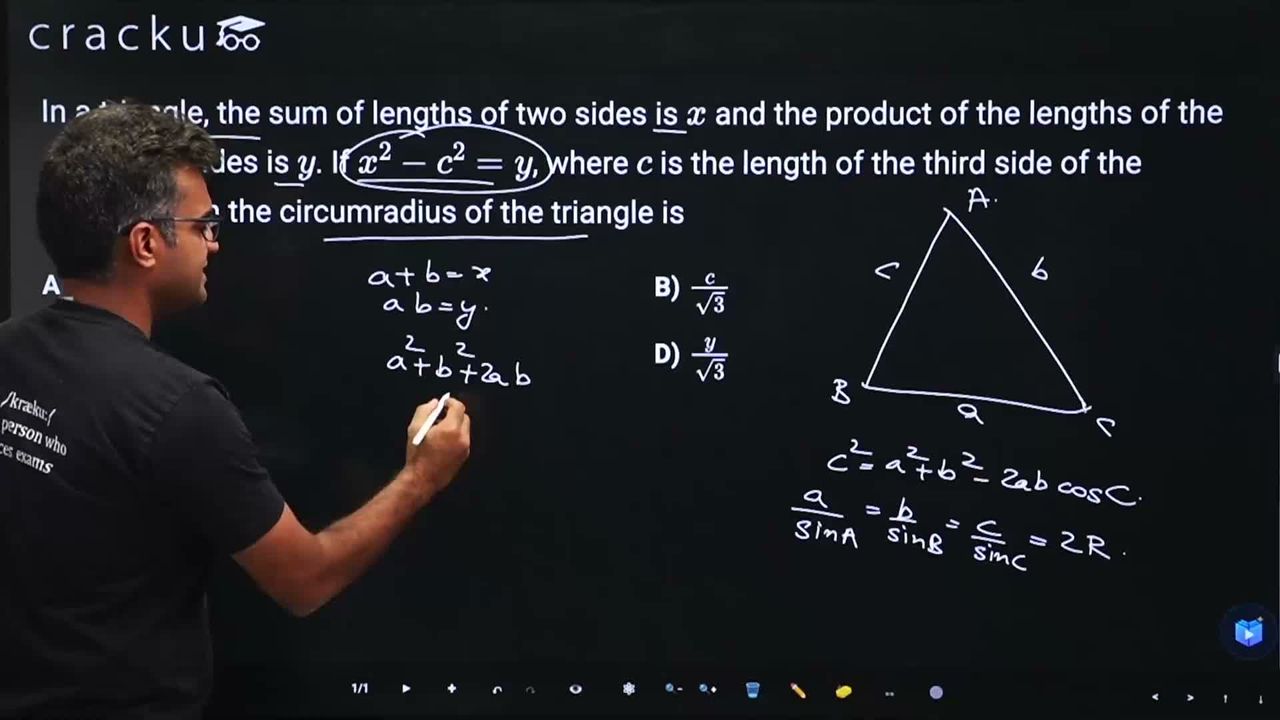
In a triangle, the sum of lengths of two sides is $$x$$ and the product of the lengths of the same two sides is $$y$$. If $$x^2 - c^2 = y$$, where $$c$$ is the length of the third side of the triangle, then the circumradius of the triangle is
Let the three sides of the triangle be denoted by $$a$$, $$b$$ and $$c$$, where $$c$$ is the side whose length is explicitly named in the question. We are told that the sum and product of the other two sides satisfy
$$a+b = x, \qquad ab = y,$$
and that these same numbers obey the relation
$$x^{2}-c^{2}=y.$$
To reach the circumradius we shall first determine the angle opposite side $$c$$. For any triangle the Law of Cosines states
$$c^{2}=a^{2}+b^{2}-2ab\cos C,$$
where $$C$$ is the angle between sides $$a$$ and $$b$$ (i.e. the angle opposite side $$c$$).
We wish to rewrite $$a^{2}+b^{2}$$ in terms of the given quantities $$x$$ and $$y$$. Using the identity
$$(a+b)^{2}=a^{2}+b^{2}+2ab,$$
we isolate $$a^{2}+b^{2}$$:
$$a^{2}+b^{2}=(a+b)^{2}-2ab=x^{2}-2y.$$
Substituting this back into the Law of Cosines gives
$$c^{2}=\,\bigl(x^{2}-2y\bigr)\,-2y\cos C.$$
We now move every term except the cosine term to the other side:
$$2y\cos C \;=\;x^{2}-2y-c^{2}.$$
But the question itself supplies $$x^{2}-c^{2}=y$$, so we replace that pair on the right:
$$2y\cos C \;=\;y-2y.$$
Simplifying,
$$2y\cos C = -\,y.$$
Provided the triangle is non-degenerate, $$y\neq 0$$, hence we can divide by $$y$$:
$$2\cos C = -1 \;\;\;\Longrightarrow\;\;\; \cos C = -\tfrac12.$$
The only angle of a triangle whose cosine equals $$-\,\frac12$$ is
$$C = 120^{\circ}.$$
With the angle known, we invoke the standard formula that links a side to the circumradius $$R$$:
$$\text{(Circumradius formula)}\quad c = 2R\sin C.$$
Using $$C=120^{\circ}$$ and recalling $$\sin120^{\circ}=\sin60^{\circ}=\frac{\sqrt3}{2},$$ we have
$$c = 2R\left(\frac{\sqrt3}{2}\right) = R\sqrt3.$$
Solving for $$R$$ yields
$$R = \frac{c}{\sqrt3}.$$
Among the listed choices this matches Option 2.
Hence, the correct answer is Option 2.
Was this solution helpful?
Click on the Email ☝️ to Watch the Video Solution
Create a FREE account and get:
_1.webp)

Educational materials for JEE preparation

Ask our AI anything

AI can make mistakes. Please verify important information.
AI can make mistakes. Please verify important information.
