
Join Our JEE Preparation Group
Prep with like-minded aspirants; Get access to free daily tests and study material.
Sign in
Please select an account to continue using cracku.in
↓ →
Join Our JEE Preparation Group
Prep with like-minded aspirants; Get access to free daily tests and study material.
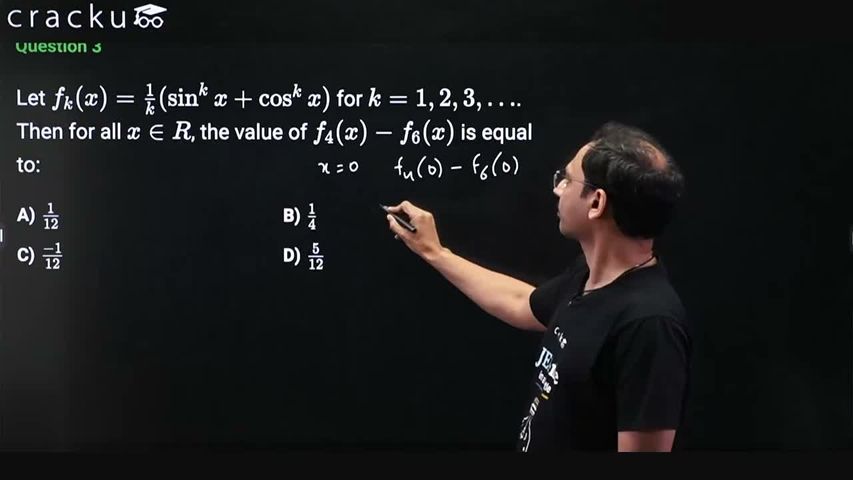
Let $$f_k(x) = \frac{1}{k}(\sin^k x + \cos^k x)$$ for $$k = 1, 2, 3, \ldots$$. Then for all $$x \in R$$, the value of $$f_4(x) - f_6(x)$$ is equal to:
We have the family of functions $$f_k(x)=\dfrac{1}{k}\bigl(\sin^{\,k}x+\cos^{\,k}x\bigr)$$ for positive integers $$k$$. We need the expression $$f_4(x)-f_6(x)$$ for every real $$x$$.
First we write the two required members of the family explicitly:
$$f_4(x)=\dfrac{1}{4}\bigl(\sin^{4}x+\cos^{4}x\bigr),\qquad f_6(x)=\dfrac{1}{6}\bigl(\sin^{6}x+\cos^{6}x\bigr).$$
To simplify $$\sin^{4}x+\cos^{4}x$$, we start from the square of the Pythagorean identity. Since $$\sin^{2}x+\cos^{2}x=1$$, squaring both sides gives
$$\bigl(\sin^{2}x+\cos^{2}x\bigr)^{2}=1^{2}=1.$$
Expanding the left side,
$$\sin^{4}x+2\sin^{2}x\cos^{2}x+\cos^{4}x=1.$$
Rearranging,
$$\sin^{4}x+\cos^{4}x=1-2\sin^{2}x\cos^{2}x.$$
Next we simplify $$\sin^{6}x+\cos^{6}x$$. We use the algebraic identity for the sum of cubes, namely $$a^{3}+b^{3}=(a+b)(a^{2}-ab+b^{2})$$. Let
$$a=\sin^{2}x,\quad b=\cos^{2}x.$$
Then
$$\sin^{6}x+\cos^{6}x=(\sin^{2}x)^{3}+(\cos^{2}x)^{3} =(a+b)\bigl(a^{2}-ab+b^{2}\bigr).$$
We already know $$a+b=\sin^{2}x+\cos^{2}x=1$$, so only $$a^{2}-ab+b^{2}$$ remains. Observe
$$a^{2}-ab+b^{2}=\sin^{4}x-\sin^{2}x\cos^{2}x+\cos^{4}x.$$
Substituting the earlier result $$\sin^{4}x+\cos^{4}x=1-2\sin^{2}x\cos^{2}x$$ gives
$$a^{2}-ab+b^{2}=(1-2\sin^{2}x\cos^{2}x)-\sin^{2}x\cos^{2}x =1-3\sin^{2}x\cos^{2}x.$$
Hence
$$\sin^{6}x+\cos^{6}x=(a+b)\bigl(a^{2}-ab+b^{2}\bigr) =1\bigl(1-3\sin^{2}x\cos^{2}x\bigr)=1-3\sin^{2}x\cos^{2}x.$$
For brevity, let us denote $$\sin^{2}x\cos^{2}x$$ by $$t$$. Therefore
$$\sin^{4}x+\cos^{4}x=1-2t,\qquad \sin^{6}x+\cos^{6}x=1-3t.$$
We now substitute these into $$f_4(x)$$ and $$f_6(x)$$:
$$f_4(x)=\dfrac{1}{4}(1-2t),\qquad f_6(x)=\dfrac{1}{6}(1-3t).$$
The desired difference becomes
$$f_4(x)-f_6(x)=\dfrac{1}{4}(1-2t)-\dfrac{1}{6}(1-3t).$$
To combine the fractions, we take the common denominator $$12$$:
$$f_4(x)-f_6(x)=\dfrac{3}{12}(1-2t)-\dfrac{2}{12}(1-3t).$$
Expanding the numerators,
$$=\dfrac{3(1-2t)-2(1-3t)}{12} =\dfrac{3-6t-2+6t}{12}.$$
The $$-6t$$ and $$+6t$$ cancel out, leaving
$$=\dfrac{1}{12}.$$
This final expression contains no $$x$$, confirming that the difference is the same for all real $$x$$. Hence, the correct answer is Option A.
Was this solution helpful?
Click on the Email ☝️ to Watch the Video Solution
Create a FREE account and get:
_1.webp)

Educational materials for JEE preparation

Ask our AI anything

AI can make mistakes. Please verify important information.
AI can make mistakes. Please verify important information.
