
Join Our JEE Preparation Group
Prep with like-minded aspirants; Get access to free daily tests and study material.
Sign in
Please select an account to continue using cracku.in
↓ →
Join Our JEE Preparation Group
Prep with like-minded aspirants; Get access to free daily tests and study material.
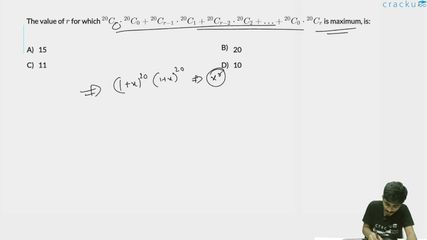
The value of $$r$$ for which $${}^{20}C_r \cdot {}^{20}C_0 + {}^{20}C_{r-1} \cdot {}^{20}C_1 + {}^{20}C_{r-2} \cdot {}^{20}C_2 + \ldots + {}^{20}C_0 \cdot {}^{20}C_r$$ is maximum, is:
We begin with the expression
$$S(r)= {}^{20}C_r \cdot {}^{20}C_0 + {}^{20}C_{r-1} \cdot {}^{20}C_1 + {}^{20}C_{r-2} \cdot {}^{20}C_2 + \ldots + {}^{20}C_0 \cdot {}^{20}C_r.$$
The general term of this finite sum can be written as $$^{20}C_{r-k}\,^{20}C_k$$ where the index $$k$$ goes from $$0$$ up to $$r$$. Hence we may rewrite the whole sum compactly as
$$S(r)=\sum_{k=0}^{r} {}^{20}C_{r-k}\,{}^{20}C_k.$$
Now we recall (and explicitly state) a standard identity that comes directly from the Binomial Theorem:
$$\bigl(1+x\bigr)^{m}\bigl(1+x\bigr)^{n}=(1+x)^{\,m+n}.$$
When we expand each factor separately and then multiply, the coefficient of $$x^t$$ on the left-hand side is obtained by convolution of the two individual coefficient sequences. In symbols,
$$\bigl[(1+x)^m\bigr]\bigl[(1+x)^n\bigr]=\sum_{t=0}^{m+n}\Bigl[\sum_{k=0}^{t}{}^{m}C_k\,{}^{n}C_{t-k}\Bigr]x^{\,t}.$$
Comparing this with the right-hand side $$ (1+x)^{m+n} $$ we see that
$$\sum_{k=0}^{t}{}^{m}C_k\,{}^{n}C_{t-k}={} ^{\,m+n}C_t. \quad -(★)$$
This is the convolution identity for binomial coefficients.
In our problem we have $$m=20,\; n=20$$ and $$t=r$$. Therefore, by direct substitution into identity (★) we get
$$S(r)=\sum_{k=0}^{r}{}^{20}C_k\,{}^{20}C_{r-k}={} ^{\,40}C_r.$$
So the given sum is precisely the single binomial coefficient $$^{40}C_r$$.
Next we determine for which integer $$r$$ (restricted here to $$0\le r\le 20$$ because $$^{20}C_{r-k}$$ vanishes whenever the upper index $$20$$ is smaller than the lower one) the value of $$^{40}C_r$$ is largest.
We use another well-known fact about binomial coefficients:
For a fixed positive integer $$N$$, the sequence $$^{N}C_0,\,^{N}C_1,\,^{N}C_2,\ldots,\,^{N}C_N$$ increases strictly up to $$r=\bigl\lfloor N/2\bigr\rfloor$$ and then decreases symmetrically, with
$$^{N}C_r=^{N}C_{N-r}.$$
Here $$N=40$$ is even, so the unique largest term is achieved at exactly
$$r=\dfrac{N}{2}=20.$$
Since all permissible $$r$$ lie between $$0$$ and $$20$$ (inclusive), the maximum clearly occurs at this central value itself.
Hence, the correct answer is Option B.
Was this solution helpful?
Click on the Email ☝️ to Watch the Video Solution
Create a FREE account and get:
_1.webp)

Educational materials for JEE preparation

Ask our AI anything

AI can make mistakes. Please verify important information.
AI can make mistakes. Please verify important information.
