
Join Our JEE Preparation Group
Prep with like-minded aspirants; Get access to free daily tests and study material.
Sign in
Please select an account to continue using cracku.in
↓ →
Join Our JEE Preparation Group
Prep with like-minded aspirants; Get access to free daily tests and study material.
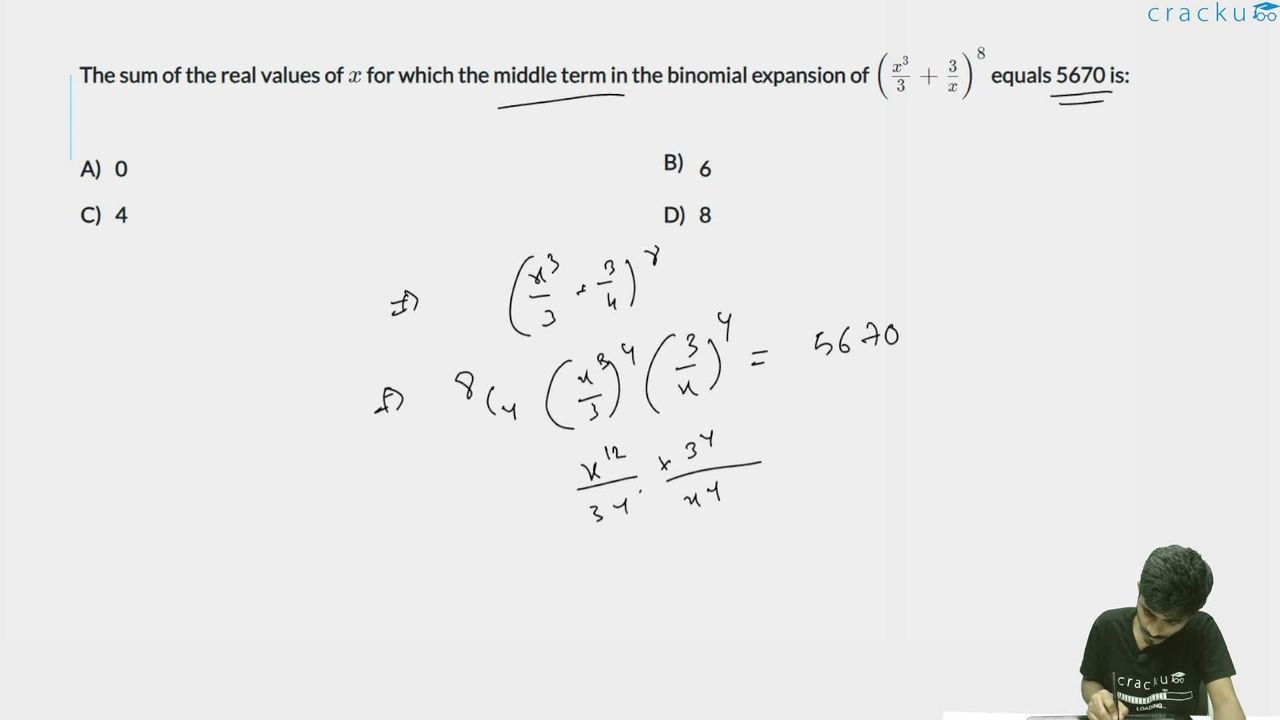
The sum of the real values of $$x$$ for which the middle term in the binomial expansion of $$\left(\frac{x^3}{3} + \frac{3}{x}\right)^8$$ equals 5670 is:
First we observe that the given expression is a binomial of the form $$(a+b)^n$$ with
$$a=\dfrac{x^{3}}{3}, \qquad b=\dfrac{3}{x}, \qquad n=8.$$
For any binomial expansion $$(a+b)^n,$$ the general term (also called the $$(k+1)$$-th term when we start counting from $$k=0$$) is
$$T_{k+1}= \binom{n}{k}\, a^{\,n-k}\, b^{\,k}.$$
The “middle term’’ is the term that comes exactly in the centre of the expansion. When the exponent $$n$$ is even, i.e. $$n=2m$$, there is a single middle term, namely the $$(m+1)$$-th term. Here $$n=8=2\times4$$, so $$m=4$$ and the middle term is the $$(4+1)$$-th term, that is $$T_{5}$$.
Putting $$k=4$$ in the general formula, we obtain
$$T_{5}= \binom{8}{4}\left(\dfrac{x^{3}}{3}\right)^{8-4}\left(\dfrac{3}{x}\right)^{4}.$$
Now we simplify each factor carefully.
First, $$\binom{8}{4}=70,$$ because $$\binom{8}{4}=\dfrac{8!}{4!\,4!}=70.$$
Next,
$$\left(\dfrac{x^{3}}{3}\right)^{8-4}=\left(\dfrac{x^{3}}{3}\right)^{4} =\dfrac{x^{3\times4}}{3^{4}} =\dfrac{x^{12}}{81}.$$
Also,
$$\left(\dfrac{3}{x}\right)^{4} =\dfrac{3^{4}}{x^{4}} =\dfrac{81}{x^{4}}.$$
Multiplying the two powers of $$x$$ together, we have
$$\dfrac{x^{12}}{81}\times\dfrac{81}{x^{4}} =x^{12}\times\dfrac{81}{81}\times\dfrac{1}{x^{4}} =x^{12}\times\dfrac{1}{x^{4}} =x^{8}.$$
Hence the middle term becomes
$$T_{5}=70\,x^{8}.$$
According to the question, this value equals $$5670$$, so we set
$$70\,x^{8}=5670.$$
Dividing both sides by $$70$$, we get
$$x^{8}=\dfrac{5670}{70}=81.$$
We recognize that $$81=3^{4},$$ so
$$x^{8}=3^{4}.$$
Taking the real eighth roots on both sides gives
$$x=\pm 3^{\,4/8}= \pm 3^{1/2}=\pm\sqrt{3}.$$
Thus there are two real solutions: $$x=\sqrt{3}\quad\text{and}\quad x=-\sqrt{3}.$$
Finally, the sum of these real values is
$$\sqrt{3}+(-\sqrt{3})=0.$$
Hence, the correct answer is Option A.
Was this solution helpful?
Click on the Email ☝️ to Watch the Video Solution
Create a FREE account and get:
_1.webp)

Educational materials for JEE preparation

Ask our AI anything

AI can make mistakes. Please verify important information.
AI can make mistakes. Please verify important information.
