
Join Our JEE Preparation Group
Prep with like-minded aspirants; Get access to free daily tests and study material.
Sign in
Please select an account to continue using cracku.in
↓ →
Join Our JEE Preparation Group
Prep with like-minded aspirants; Get access to free daily tests and study material.
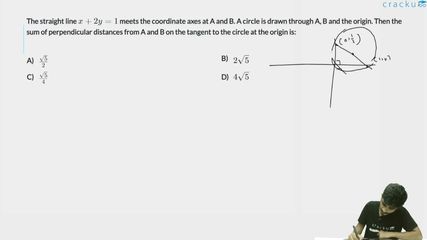
The straight line $$x + 2y = 1$$ meets the coordinate axes at A and B. A circle is drawn through A, B and the origin. Then the sum of perpendicular distances from A and B on the tangent to the circle at the origin is:
We have the straight line $$x + 2y = 1$$. To find the points where it meets the coordinate axes, we put one coordinate equal to zero at a time.
For the $$x$$-axis we set $$y = 0$$, giving $$x + 2(0) = 1 \implies x = 1$$. Hence the point is $$A(1,\,0)$$.
For the $$y$$-axis we set $$x = 0$$, giving $$0 + 2y = 1 \implies y = \dfrac12$$. Hence the point is $$B\!\left(0,\,\dfrac12\right)$$.
The circle is required to pass through $$A(1,0)$$, $$B\!\left(0,\dfrac12\right)$$ and the origin $$O(0,0)$$. The general equation of a circle whose centre is not yet known is stated first:
$$x^{2} + y^{2} + 2gx + 2fy + c = 0.$$
Because the origin lies on the circle, substituting $$x = 0,\; y = 0$$ gives $$c = 0$$. Thus the equation reduces to
$$x^{2} + y^{2} + 2gx + 2fy = 0.$$
Next we impose the condition that $$A(1,0)$$ lies on the circle. Substituting $$x = 1,\; y = 0$$ we get
$$1^{2} + 0^{2} + 2g(1) + 2f(0) = 0 \;\;\Longrightarrow\;\; 1 + 2g = 0 \;\;\Longrightarrow\;\; g = -\dfrac12.$$
Now we impose the condition that $$B\!\left(0,\dfrac12\right)$$ lies on the circle. Substituting $$x = 0,\; y = \dfrac12$$ we get
$$0^{2} + \left(\dfrac12\right)^{2} + 2g(0) + 2f\!\left(\dfrac12\right) = 0 \;\;\Longrightarrow\;\; \dfrac14 + f = 0 \;\;\Longrightarrow\;\; f = -\dfrac14.$$
Hence the circle’s equation is
$$x^{2} + y^{2} + 2\!\left(-\dfrac12\right)x + 2\!\left(-\dfrac14\right)y = 0,$$
which simplifies to
$$x^{2} + y^{2} - x - \dfrac12\,y = 0.$$
We now determine the tangent to this circle at the origin. The standard tangent formula for a circle $$x^{2} + y^{2} + 2gx + 2fy + c = 0$$ at the point $$(x_{1},y_{1})$$ on the circle is
$$xx_{1} + yy_{1} + g(x + x_{1}) + f(y + y_{1}) + c = 0.$$
For the origin we have $$(x_{1},y_{1}) = (0,0)$$ and $$c = 0,$$ so the equation becomes simply
$$g\,x + f\,y = 0.$$
Substituting $$g = -\dfrac12$$ and $$f = -\dfrac14,$$ we obtain
$${-}\dfrac12\,x \;+\; {-}\dfrac14\,y = 0 \;\;\Longrightarrow\;\; 2x + y = 0$$
after multiplying by $$-4$$ for convenience. Thus the tangent at the origin is the straight line
$$2x + y = 0.$$
We now calculate the perpendicular distance of each of the points $$A$$ and $$B$$ from this tangent. The distance of a point $$(x_{0},y_{0})$$ from a line $$ax + by + c = 0$$ is given by the formula
$$\text{Distance} = \dfrac{|ax_{0} + by_{0} + c|}{\sqrt{a^{2} + b^{2}}}.$$
For the line $$2x + y + 0 = 0$$ we have $$a = 2,\; b = 1,\; c = 0,$$ so $$\sqrt{a^{2} + b^{2}} = \sqrt{2^{2} + 1^{2}} = \sqrt5.$$
Distance from $$A(1,0):$$}
Numerator $$= |2(1) + 1(0) + 0| = |2| = 2.$$
Therefore $$d_{A} = \dfrac{2}{\sqrt5}.$$
Distance from $$B\!\left(0,\dfrac12\right):$$}
Numerator $$= |2(0) + 1\!\left(\dfrac12\right) + 0| = \left|\dfrac12\right| = \dfrac12.$$
Therefore $$d_{B} = \dfrac{\dfrac12}{\sqrt5} = \dfrac1{2\sqrt5}.$$
Adding the two distances we get
$$d_{A} + d_{B} = \dfrac{2}{\sqrt5} \;+\; \dfrac{1}{2\sqrt5} = \dfrac{4}{2\sqrt5} \;+\; \dfrac{1}{2\sqrt5} = \dfrac{5}{2\sqrt5}.$$
To simplify, write $$\dfrac{5}{2\sqrt5} = \dfrac{5}{2}\cdot\dfrac{1}{\sqrt5} = \dfrac{5}{2}\cdot\dfrac{\sqrt5}{5} = \dfrac{\sqrt5}{2}.$$
Hence, the sum of the perpendicular distances from $$A$$ and $$B$$ to the tangent at the origin is $$\dfrac{\sqrt5}{2}$$.
Hence, the correct answer is Option A.
Was this solution helpful?
Click on the Email ☝️ to Watch the Video Solution
Create a FREE account and get:
_1.webp)

Educational materials for JEE preparation

Ask our AI anything

AI can make mistakes. Please verify important information.
AI can make mistakes. Please verify important information.
