
Join Our JEE Preparation Group
Prep with like-minded aspirants; Get access to free daily tests and study material.
Sign in
Please select an account to continue using cracku.in
↓ →
Join Our JEE Preparation Group
Prep with like-minded aspirants; Get access to free daily tests and study material.
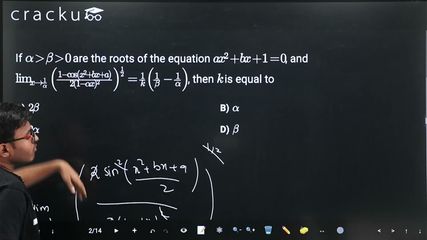
If $$\alpha > \beta > 0$$ are the roots of the equation $$ax^2 + bx + 1 = 0$$, and
$$\lim_{x \to \frac{1}{\alpha}} \left(\frac{1 - \cos(x^2 + bx + a)}{2(1 - \alpha x)^2}\right)^{\frac{1}{2}} = \frac{1}{k}\left(\frac{1}{\beta} - \frac{1}{\alpha}\right)$$, then $$k$$ is equal to
We are given that $$\alpha > \beta > 0$$ are the roots of the equation $$ax^2 + bx + 1 = 0$$, and we need to find the value of $$k$$.
To begin,
Since $$\alpha$$ and $$\beta$$ are roots of $$ax^2 + bx + 1 = 0$$, we can write:
$$ax^2 + bx + 1 = a(x - \alpha)(x - \beta)$$
Dividing both sides by $$a$$:
$$x^2 + \frac{b}{a}x + \frac{1}{a} = (x - \alpha)(x - \beta)$$
Now consider $$x^2 + bx + a$$. The roots of $$x^2 + bx + a = 0$$ can be found by substituting $$x \to \frac{1}{x}$$ in the original equation. From $$ax^2 + bx + 1 = 0$$, replacing $$x$$ with $$\frac{1}{x}$$:
$$\frac{a}{x^2} + \frac{b}{x} + 1 = 0 \implies a + bx + x^2 = 0$$
So the roots of $$x^2 + bx + a = 0$$ are $$\frac{1}{\alpha}$$ and $$\frac{1}{\beta}$$. Therefore:
$$x^2 + bx + a = \left(x - \frac{1}{\alpha}\right)\left(x - \frac{1}{\beta}\right)$$
Next,
As $$x \to \frac{1}{\alpha}$$, we have $$x^2 + bx + a \to 0$$. Using the approximation $$1 - \cos\theta \approx \frac{\theta^2}{2}$$ for small $$\theta$$:
$$\sqrt{\frac{1 - \cos(x^2 + bx + a)}{2(1 - \alpha x)^2}} \approx \sqrt{\frac{(x^2 + bx + a)^2}{4(1 - \alpha x)^2}} = \frac{|x^2 + bx + a|}{2|1 - \alpha x|}$$
From this,
We have $$x^2 + bx + a = \left(x - \frac{1}{\alpha}\right)\left(x - \frac{1}{\beta}\right)$$ and $$1 - \alpha x = -\alpha\left(x - \frac{1}{\alpha}\right)$$.
$$\frac{\left|x - \frac{1}{\alpha}\right| \cdot \left|x - \frac{1}{\beta}\right|}{2\alpha\left|x - \frac{1}{\alpha}\right|} = \frac{\left|x - \frac{1}{\beta}\right|}{2\alpha}$$
Continuing,
As $$x \to \frac{1}{\alpha}$$:
$$\frac{\left|\frac{1}{\alpha} - \frac{1}{\beta}\right|}{2\alpha}$$
Since $$\alpha > \beta > 0$$, we have $$\frac{1}{\alpha} < \frac{1}{\beta}$$, so $$\left|\frac{1}{\alpha} - \frac{1}{\beta}\right| = \frac{1}{\beta} - \frac{1}{\alpha}$$.
$$\text{Limit} = \frac{1}{2\alpha}\left(\frac{1}{\beta} - \frac{1}{\alpha}\right)$$
Now,
We are told the limit equals $$\frac{1}{k}\left(\frac{1}{\beta} - \frac{1}{\alpha}\right)$$. Comparing:
$$\frac{1}{k} = \frac{1}{2\alpha} \implies k = 2\alpha$$
The answer is Option C: $$2\alpha$$.
Was this solution helpful?
Click on the Email ☝️ to Watch the Video Solution
Create a FREE account and get:
_1.webp)

Educational materials for JEE preparation

Ask our AI anything

AI can make mistakes. Please verify important information.
AI can make mistakes. Please verify important information.


