
Join Our JEE Preparation Group
Prep with like-minded aspirants; Get access to free daily tests and study material.
Sign in
Please select an account to continue using cracku.in
↓ →
Join Our JEE Preparation Group
Prep with like-minded aspirants; Get access to free daily tests and study material.
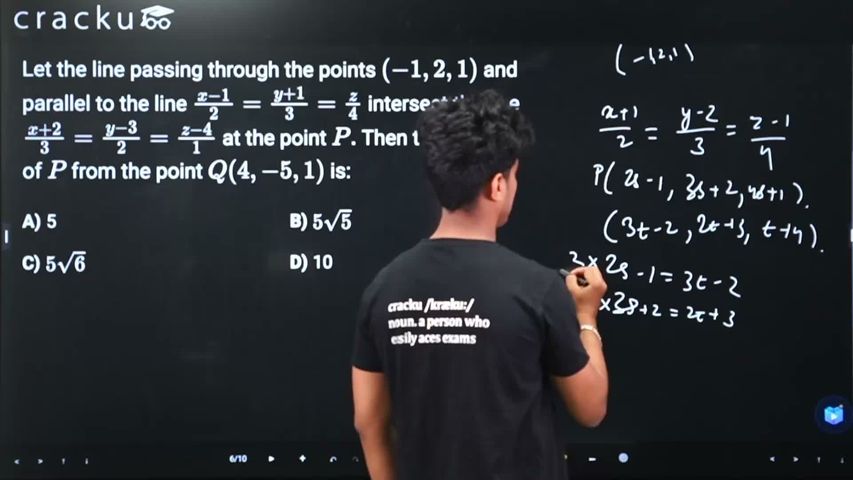
Let the line passing through the points $$(-1,2,1)$$ and parallel to the line $$\frac{x-1}{2}=\frac{y+1}{3}=\frac{z}{4}$$ intersect the line $$\frac{x+2}{3}=\frac{y-3}{2}=\frac{z-4}{1}$$ at the point $$P.$$ Then the distance of $$P$$ from the point $$Q(4,-5,1)$$ is:
A line through (−1,2,1) parallel to the direction (2,3,4) intersects the line $$\frac{x+2}{3}=\frac{y-3}{2}=\frac{z-4}{1}$$ at P. To find P, we parametrize the first line as $$(-1+2s,\,2+3s,\,1+4s)$$ and the second line as $$(-2+3t,\,3+2t,\,4+t)\,$$.
Equating the coordinates yields the system:
$$-1+2s=-2+3t\quad\Rightarrow\quad2s-3t=-1$$
$$2+3s=3+2t\quad\Rightarrow\quad3s-2t=1$$
$$1+4s=4+t\quad\Rightarrow\quad4s-t=3$$.
From the second equation, $$t=\frac{3s-1}{2}\,. $$ Substituting into the first gives
$$2s-3\cdot\frac{3s-1}{2}=-1\quad\Rightarrow\quad4s-9s+3=-2\quad\Rightarrow\quad-5s=-5\quad\Rightarrow\quad s=1,$$
so $$t=\frac{3(1)-1}{2}=1\,. $$ Checking the third equation confirms $$4(1)-1=3\,. $$
Hence $$P=(-1+2\,,\,2+3\,,\,1+4)=(1,5,5)\,. $$ The distance from P to $$Q(4,-5,1)$$ is $$\sqrt{(4-1)^2+(-5-5)^2+(1-5)^2}=\sqrt{9+100+16}=\sqrt{125}=5\sqrt{5}\,. $$
The correct answer is Option 2: $$5\sqrt{5}$$.
Was this solution helpful?
Click on the Email ☝️ to Watch the Video Solution
Create a FREE account and get:
_1.webp)

Educational materials for JEE preparation

Ask our AI anything

AI can make mistakes. Please verify important information.
AI can make mistakes. Please verify important information.
