
Join Our JEE Preparation Group
Prep with like-minded aspirants; Get access to free daily tests and study material.
Sign in
Please select an account to continue using cracku.in
↓ →
Join Our JEE Preparation Group
Prep with like-minded aspirants; Get access to free daily tests and study material.
Given below are two statements :
Statement I:
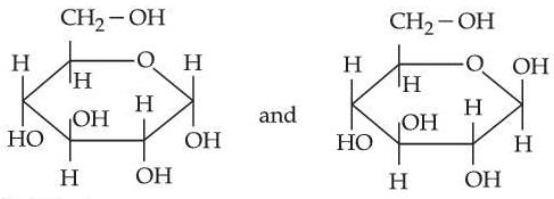
are two anomers of D-(+)-glucose.
Statement II: the Open chain forms of D-glucose and D-fructose contain three similar chiral carbons at C₃, C₄, and C₅.
In the light of the above statements, choose the correct answer from the options given below:
To determine the correct answer, we analyze both statements using the principles of carbohydrate chemistry.
The given structures differ only in the configuration of the hydroxyl group at the anomeric carbon ($$C_1$$). Anomers are a special type of epimers that differ only in the configuration at the anomeric carbon formed during cyclization. Since one structure has the hydroxyl group in the $$\alpha$$-orientation and the other in the $$\beta$$-orientation, they represent the $$\alpha$$- and $$\beta$$-anomers of D-(+)-glucose. Therefore, Statement I is true.
The open-chain form of D-glucose is $$CHO-CH(OH)-CH(OH)-CH(OH)-CH(OH)-CH_2OH$$, with chiral carbon atoms at $$C_2$$, $$C_3$$, $$C_4$$, and $$C_5$$. The open-chain form of D-fructose is $$CH_2OH-C(=O)-CH(OH)-CH(OH)-CH(OH)-CH_2OH$$, with chiral carbon atoms at $$C_3$$, $$C_4$$, and $$C_5$$. The configurations at $$C_3$$, $$C_4$$, and $$C_5$$ are identical in both molecules, so they possess three similar chiral carbon atoms at these positions. Therefore, Statement II is also true.
Hence, both Statement I and Statement II are true, and the correct answer is Option (A).
Was this solution helpful?
Click on the Email ☝️ to Watch the Video Solution
Create a FREE account and get:
_1.webp)

Educational materials for JEE preparation

Ask our AI anything

AI can make mistakes. Please verify important information.
AI can make mistakes. Please verify important information.
