
Join Our JEE Preparation Group
Prep with like-minded aspirants; Get access to free daily tests and study material.
Sign in
Please select an account to continue using cracku.in
↓ →
Join Our JEE Preparation Group
Prep with like-minded aspirants; Get access to free daily tests and study material.
The value of $$\lim_{x \to 0}\left(\frac{x}{\sqrt[8]{1 - \sin x} - \sqrt[8]{1 + \sin x}}\right)$$ is equal to:
We have to evaluate the following limit as $$x$$ tends to $$0$$
$$\displaystyle L=\lim_{x\rightarrow 0}\left(\frac{x}{\sqrt[8]{1-\sin x}-\sqrt[8]{1+\sin x}}\right)\;.-(1)$$
Because $$x\rightarrow 0$$, the quantity $$\sin x$$ is also very small. For any small number $$u$$ we may employ the binomial (or Taylor) expansion of $$(1+u)^{\alpha}$$:
$$\displaystyle (1+u)^{\alpha}=1+\alpha\,u+\frac{\alpha(\alpha-1)}{2}\,u^{2}+O(u^{3}).-(2)$$
Here $$\alpha=\dfrac18$$. Let us set
$$u_{1}=-\sin x,\qquad u_{2}=+\sin x.$$(3)
Applying (2) individually to the two eighth-root expressions gives
$$\sqrt[8]{1-\sin x}=(1+u_{1})^{1/8}=1+\frac18\,u_{1}+\frac{\dfrac18\!\left(\dfrac18-1\right)}2\,u_{1}^{2}+O(u_{1}^{3}),-(4)$$
$$\sqrt[8]{1+\sin x}=(1+u_{2})^{1/8}=1+\frac18\,u_{2}+\frac{\dfrac18\!\left(\dfrac18-1\right)}2\,u_{2}^{2}+O(u_{2}^{3}).-(5)$$
Because $$u_{1}=-\sin x$$ and $$u_{2}=+\sin x$$, their second powers $$u_{1}^{2}$$ and $$u_{2}^{2}$$ are identical; hence those quadratic terms will cancel when we subtract (5) from (4). Subtracting (5) from (4) we obtain
$$\sqrt[8]{1-\sin x}-\sqrt[8]{1+\sin x}=\left[1+\frac18(-\sin x)\right]-\left[1+\frac18(\sin x)\right]+O\!\left((\sin x)^{3}\right).-(6)$$
Simplifying (6):
$$\sqrt[8]{1-\sin x}-\sqrt[8]{1+\sin x}=-\frac18\sin x-\frac18\sin x+O\!\left((\sin x)^{3}\right)= -\frac14\,\sin x+O\!\left((\sin x)^{3}\right).-(7)$$
Near $$x=0$$ the dominant part of the denominator is therefore $$-\dfrac14\sin x$$. Insert (7) into the original fraction (1):
$$\frac{x}{\sqrt[8]{1-\sin x}-\sqrt[8]{1+\sin x}}=\frac{x}{-\dfrac14\sin x+O\!\left((\sin x)^{3}\right)}. -(8)$$
For very small $$x$$ we may divide numerator and denominator by $$x$$, recalling that $$\displaystyle\lim_{x\rightarrow 0}\frac{\sin x}{x}=1$$ :
$$\frac{x}{-\dfrac14\sin x+O\!\left((\sin x)^{3}\right)}=\frac{x}{-\dfrac14\sin x}\left[1+O\!\left((\sin x)^{2}\right)\right].-(9)$$
The factor inside the square brackets in (9) approaches $$1$$ as $$x\rightarrow 0$$, so the limit becomes
$$L=\lim_{x\rightarrow 0}\left[\frac{x}{-\dfrac14\sin x}\right]=\lim_{x\rightarrow 0}\left[-4\cdot\frac{x}{\sin x}\right]= -4\cdot 1 = -4.\;(10)$$
Hence, the correct answer is Option 3.
Was this solution helpful?
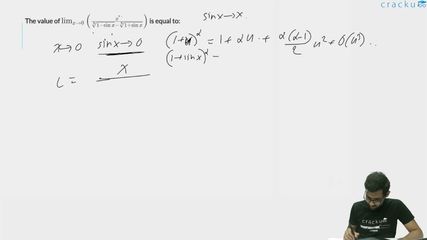
Click on the Email ☝️ to Watch the Video Solution
Create a FREE account and get:
_1.webp)

Educational materials for JEE preparation

Ask our AI anything

AI can make mistakes. Please verify important information.
AI can make mistakes. Please verify important information.
