
Join Our JEE Preparation Group
Prep with like-minded aspirants; Get access to free daily tests and study material.
Sign in
Please select an account to continue using cracku.in
↓ →
Join Our JEE Preparation Group
Prep with like-minded aspirants; Get access to free daily tests and study material.
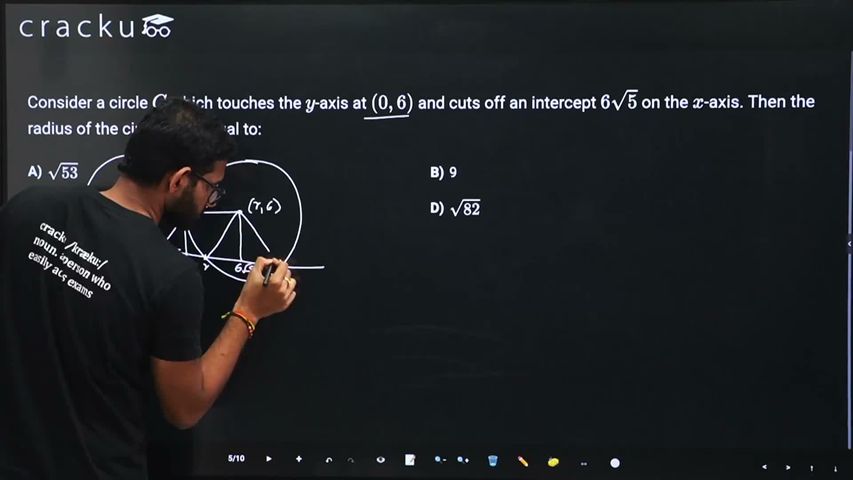
Consider a circle $$C$$ which touches the $$y$$-axis at $$(0, 6)$$ and cuts off an intercept $$6\sqrt{5}$$ on the $$x$$-axis. Then the radius of the circle $$C$$ is equal to:
The circle is tangent to the $$y$$-axis at the point $$(0,6)$$. Whenever a circle touches a line, the radius drawn to the point of contact is perpendicular to that line. Here the tangent line is the $$y$$-axis, whose equation is $$x=0$$. Hence the centre of the circle must lie exactly one radius away from this line, on the horizontal through $$(0,6)$$. So if we denote the radius by $$r$$, the centre is $$(r,\,6)$$. (The $$x$$-coordinate is $$r$$ units to the right of the $$y$$-axis, while the $$y$$-coordinate remains $$6$$ to stay level with the point of contact.)
With centre $$(r,6)$$ and radius $$r$$, the equation of the circle is
$$ (x-r)^2 + (y-6)^2 = r^2. $$
Now we use the information about the intercept on the $$x$$-axis. The $$x$$-axis is the line $$y = 0$$. To find the points where the circle meets this axis we substitute $$y = 0$$ in the equation:
$$ (x - r)^2 + (0 - 6)^2 = r^2. $$
Simplifying the constant term, we get
$$ (x - r)^2 + 36 = r^2. $$
Rearranging,
$$ (x - r)^2 = r^2 - 36. $$
Taking square roots gives the two intersection $$x$$-coordinates:
$$ x = r \pm \sqrt{\,r^2 - 36\,}. $$
Thus the two points of intersection on the $$x$$-axis are
$$\bigl(r - \sqrt{r^2 - 36},\,0\bigr) \quad\text{and}\quad \bigl(r + \sqrt{r^2 - 36},\,0\bigr).$$
The length of the intercept cut off on the $$x$$-axis is the horizontal distance between these two points. Subtracting their $$x$$-coordinates,
$$ \text{Intercept length} = \bigl[r + \sqrt{r^2 - 36}\bigr] - \bigl[r - \sqrt{r^2 - 36}\bigr] = 2\sqrt{\,r^2 - 36\,}. $$
We are told that this length equals $$6\sqrt{5}$$, so
$$ 2\sqrt{\,r^2 - 36\,} = 6\sqrt{5}. $$
Dividing both sides by $$2$$, we have
$$ \sqrt{\,r^2 - 36\,} = 3\sqrt{5}. $$
Now we square both sides (since both sides are non-negative):
$$ r^2 - 36 = \bigl(3\sqrt{5}\bigr)^2 = 9 \times 5 = 45. $$
Adding $$36$$ to both sides gives
$$ r^2 = 45 + 36 = 81. $$
Finally, taking the positive square root (radius is always positive),
$$ r = 9. $$
Hence, the correct answer is Option B.
Was this solution helpful?
Click on the Email ☝️ to Watch the Video Solution
Create a FREE account and get:
_1.webp)

Educational materials for JEE preparation

Ask our AI anything

AI can make mistakes. Please verify important information.
AI can make mistakes. Please verify important information.
