
Join Our JEE Preparation Group
Prep with like-minded aspirants; Get access to free daily tests and study material.
Sign in
Please select an account to continue using cracku.in
↓ →
Join Our JEE Preparation Group
Prep with like-minded aspirants; Get access to free daily tests and study material.
Identify the incorrect statements.
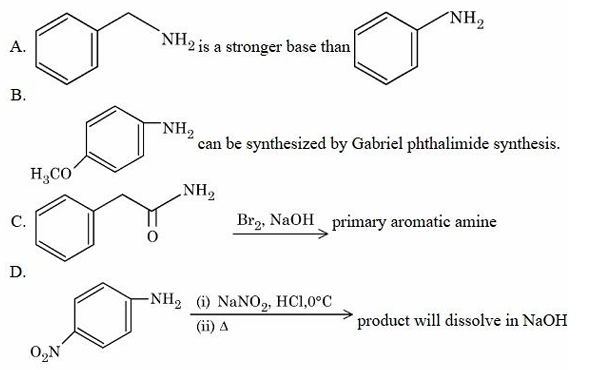
Choose the correct answer from the options given below:
In benzylamine, the lone pair on nitrogen is localized and is not involved in resonance with the benzene ring. In aniline, the lone pair is delocalized into the aromatic ring through resonance, making it less available for protonation. Therefore, benzylamine is more basic than aniline. Hence, statement A is correct.
Gabriel phthalimide synthesis is used for the preparation of primary aliphatic amines and proceeds through an $$S_N2$$ mechanism. Primary aromatic amines such as $$p$$-methoxyaniline cannot be prepared by this method because aryl halides do not undergo $$S_N2$$ substitution. Hence, statement B is incorrect.
In Hoffmann bromamide degradation, an amide is converted into a primary amine containing one less carbon atom. Thus,
$$\mathrm{PhCH_2CONH_2 \xrightarrow{Br_2/NaOH} PhCH_2NH_2}$$
The product, benzylamine, is a primary aliphatic amine since the $$-NH_2$$ group is attached to an $$sp^3$$ hybridized carbon and not directly to the benzene ring. Hence, statement C is incorrect.
Treatment of $$p$$-nitroaniline with $$NaNO_2/HCl$$ at $$0^\circ\mathrm{C}$$ forms the corresponding diazonium salt, which on heating with water undergoes hydrolysis to give $$p$$-nitrophenol. Since $$p$$-nitrophenol is acidic, it dissolves in aqueous $$NaOH$$ forming its sodium salt. Hence, statement D is correct.
Therefore, the incorrect statements are B and C only.
Was this solution helpful?
Click on the Email ☝️ to Watch the Video Solution
Create a FREE account and get:
_1.webp)

Educational materials for JEE preparation

Ask our AI anything

AI can make mistakes. Please verify important information.
AI can make mistakes. Please verify important information.


