
Join Our JEE Preparation Group
Prep with like-minded aspirants; Get access to free daily tests and study material.
Sign in
Please select an account to continue using cracku.in
↓ →
Join Our JEE Preparation Group
Prep with like-minded aspirants; Get access to free daily tests and study material.
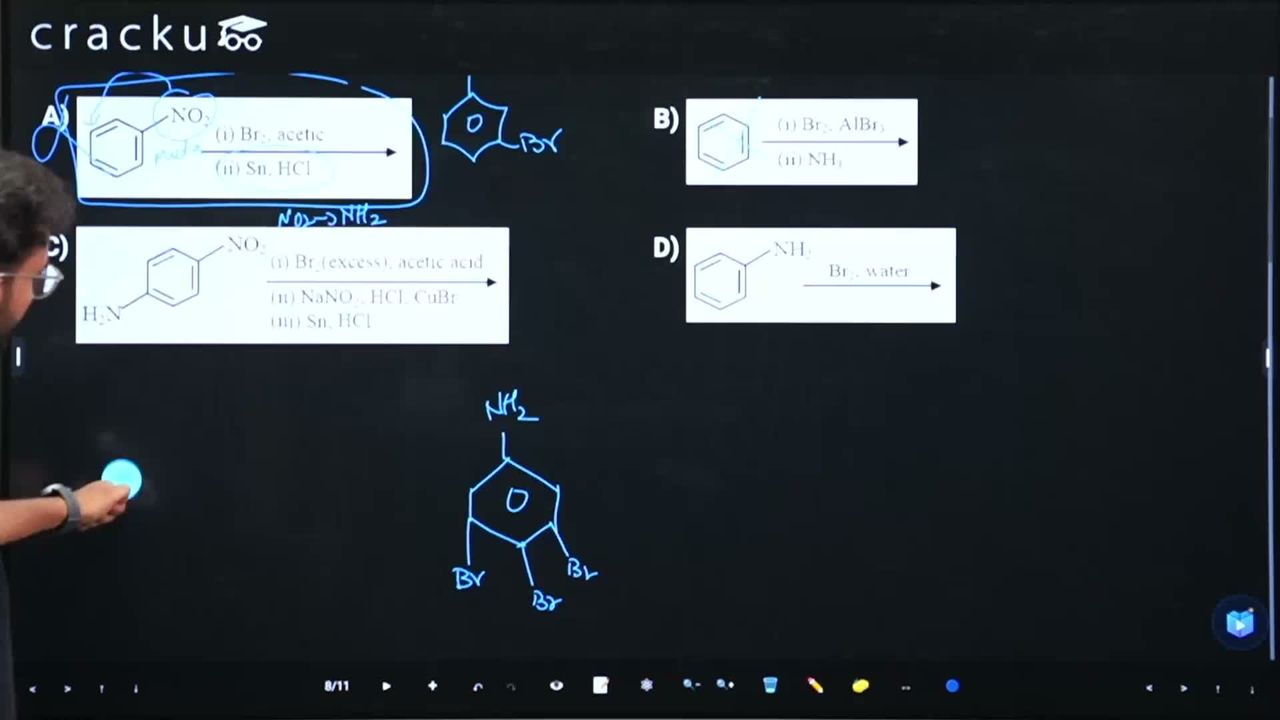
The sequence from the following that would result in giving predominantly 3,4,5-Tribromoaniline is:
Direct bromination of aniline does not produce 3,4,5-tribromoaniline because the strongly activating $$-NH_2$$ group directs substitution to the ortho and para positions, giving 2,4,6-tribromoaniline.
Therefore, an indirect synthetic route must be followed.
The correct sequence is option (C).
In the first step, p-nitroaniline is treated with excess bromine in acetic acid.
The amino group ($-NH_2$) is a strong ortho/para director and dominates the directing influence of the nitro group.
Since the para position is already occupied by $$-NO_2$$, bromination occurs at both ortho positions.
The product formed is 2,6-dibromo-4-nitroaniline.
In the second step, the amino group is converted into a diazonium salt using
$$NaNO_2/HCl.$$
The diazonium group is then replaced by bromine through the Sandmeyer reaction using
$$CuBr.$$
This transformation replaces the original $$-NH_2$$ group with a bromine atom, producing 3,4,5-tribromonitrobenzene after appropriate numbering.
In the final step, the nitro group is reduced using
$$Sn/HCl,$$
converting
$$-NO_2 \longrightarrow -NH_2.$$
The final product obtained is 3,4,5-tribromoaniline.
The remaining options do not produce the desired compound:
Hence, the correct sequence is option (C).
Was this solution helpful?
Click on the Email ☝️ to Watch the Video Solution
Create a FREE account and get:
_1.webp)

Educational materials for JEE preparation

Ask our AI anything

AI can make mistakes. Please verify important information.
AI can make mistakes. Please verify important information.
