
Join Our JEE Preparation Group
Prep with like-minded aspirants; Get access to free daily tests and study material.
Sign in
Please select an account to continue using cracku.in
↓ →
Join Our JEE Preparation Group
Prep with like-minded aspirants; Get access to free daily tests and study material.
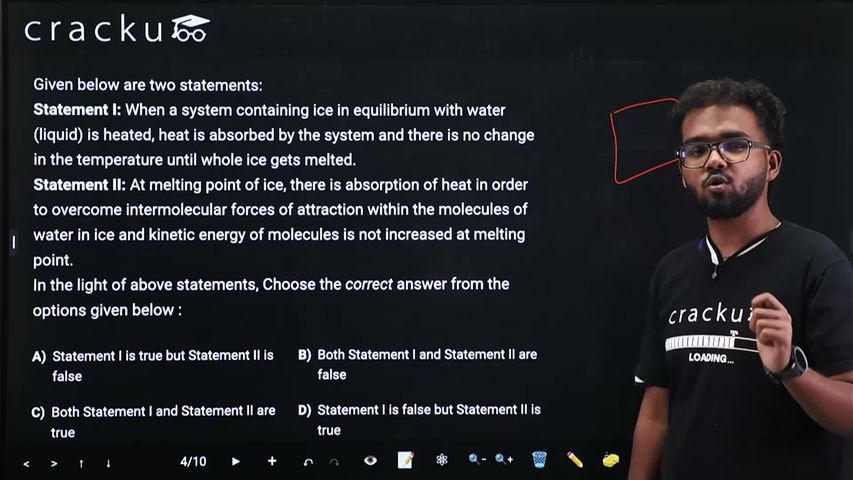
Given below are two statements:
Statement I: When a system containing ice in equilibrium with water (liquid) is heated, heat is absorbed by the system and there is no change in the temperature until whole ice gets melted.
Statement II: At melting point of ice, there is absorption of heat in order to overcome intermolecular forces of attraction within the molecules of water in ice and kinetic energy of molecules is not increased at melting point.
In the light of above statements, Choose the correct answer from the options given below :
When a pure substance changes phase at constant pressure, the temperature remains fixed until the entire conversion is complete. The energy supplied during the phase change is called latent heat and is used only to break or loosen intermolecular forces; it does not raise the average kinetic energy of the molecules.
Case 1 - Verification of Statement I
Consider ice in equilibrium with liquid water at $$0^{\circ}\text{C}$$ and $$1\text{ atm}$$ pressure. If we supply heat, the system absorbs an amount $$Q$$ given by the latent-heat relation $$Q = mL_f$$, where $$m$$ is the mass of ice and $$L_f$$ is the latent heat of fusion of ice.
During this period: temperature = $$0^{\circ}\text{C}$$ (constant), phase = mixture of solid and liquid. Only after the last crystal of ice has melted can the temperature of the liquid water start to rise. Hence Statement I is correct.
Case 2 - Verification of Statement II
At the melting point, the absorbed heat serves to weaken and break the extensive hydrogen-bond network that holds water molecules rigidly in the ice lattice. Because this energy goes into overcoming intermolecular attractions, the average kinetic energy of the molecules (which determines temperature) does not increase. Therefore no rise in temperature is observed until melting is complete. Hence Statement II is also correct.
Since both statements accurately describe what happens at the melting point of ice, the correct choice is Option C.
Final answer: Option C (Both Statement I and Statement II are true).
Was this solution helpful?
Click on the Email ☝️ to Watch the Video Solution
Create a FREE account and get:
_1.webp)

Educational materials for JEE preparation

Ask our AI anything

AI can make mistakes. Please verify important information.
AI can make mistakes. Please verify important information.
