
Join Our JEE Preparation Group
Prep with like-minded aspirants; Get access to free daily tests and study material.
Sign in
Please select an account to continue using cracku.in
↓ →
Join Our JEE Preparation Group
Prep with like-minded aspirants; Get access to free daily tests and study material.
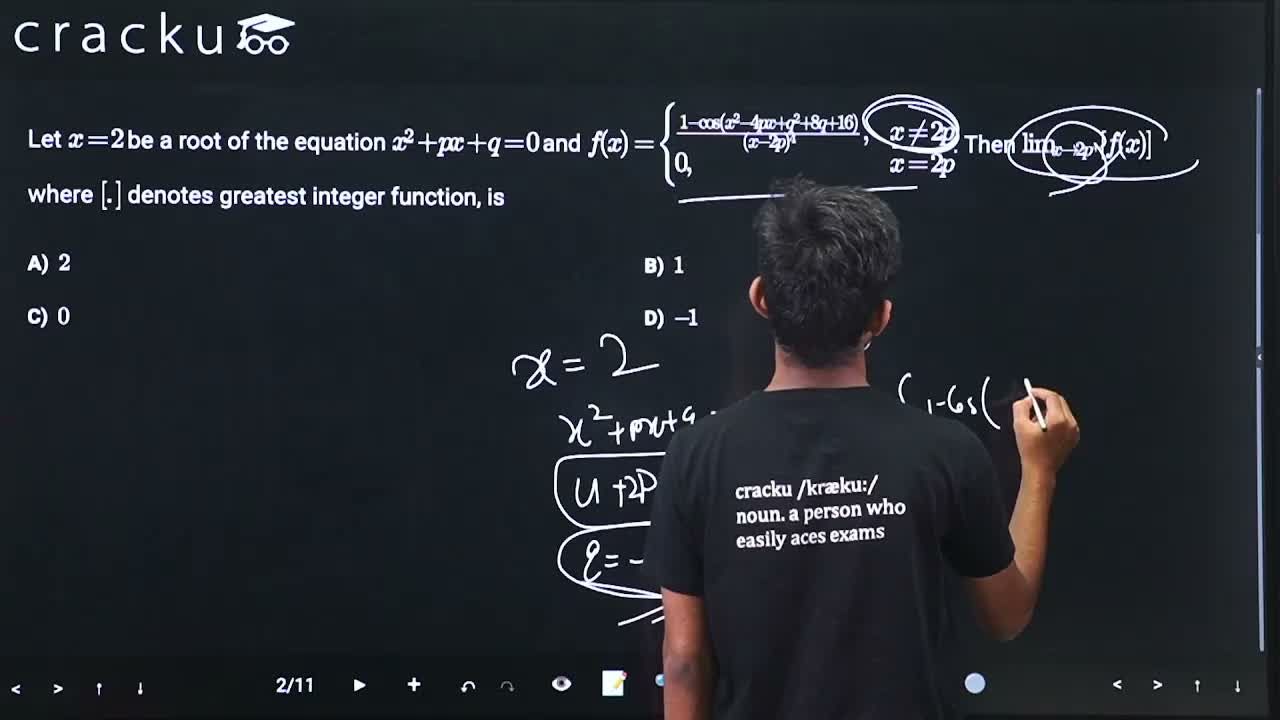
Let $$x = 2$$ be a root of the equation $$x^2 + px + q = 0$$ and $$f(x) = \begin{cases} \frac{1-\cos(x^2-4px+q^2+8q+16)}{(x-2p)^4}, & x \neq 2p \\ 0, & x = 2p \end{cases}$$. Then $$\lim_{x \to 2p^+} [f(x)]$$
where $$[.]$$ denotes greatest integer function, is
To find the value of the limit, we first simplify the expression inside the cosine function using the given root condition.
Since $$x = 2$$ is a root of the quadratic equation $$x^2 + px + q = 0$$, substituting $$x = 2$$ gives:
$$2^2 + p(2) + q = 0 \implies 4 + 2p + q = 0 \implies q + 4 = -2p$$
---
Step 1: Simplify the argument of the cosine function
Let the algebraic expression inside the cosine be $$g(x)$$:
$$g(x) = x^2 - 4px + q^2 + 8q + 16$$
Recognizing the perfect square formula for the last three terms:
$$q^2 + 8q + 16 = (q + 4)^2$$
Substituting $$(q + 4) = -2p$$ into this perfect square:
$$(q + 4)^2 = (-2p)^2 = 4p^2$$
Now substitute this back into the full expression for $$g(x)$$:
$$g(x) = x^2 - 4px + 4p^2 = (x - 2p)^2$$
---
Step 2: Rewrite the function $$f(x)$$ for $$x \neq 2p$$
Substituting the simplified argument back into the definition of $$f(x)$$:
$$f(x) = \frac{1 - \cos((x - 2p)^2)}{(x - 2p)^4}$$
Let $$u = (x - 2p)^2$$. As $$x \to 2p^+$$, we have $$u \to 0^+$$. The function becomes:
$$f(x) = \frac{1 - \cos u}{u^2}$$
---
Step 3: Analyze the behavior of $$f(x)$$ near $$u = 0$$
Using the Taylor series expansion for $$\cos u$$ around 0:
$$\cos u = 1 - \frac{u^2}{2!} + \frac{u^4}{4!} - \dots = 1 - \frac{u^2}{2} + \frac{u^4}{24} - \dots$$
Substituting this series into the function expression:
$$f(x) = \frac{1 - \left(1 - \frac{u^2}{2} + \frac{u^4}{24} - \dots\right)}{u^2}$$
$$f(x) = \frac{\frac{u^2}{2} - \frac{u^4}{24} + \dots}{u^2} = \frac{1}{2} - \frac{u^2}{24} + \dots$$
For small positive values of $$u$$ (since $$u = (x-2p)^2 > 0$$ as $$x \to 2p^+$$), the term $$-\frac{u^2}{24}$$ is strictly negative. This means that as $$x$$ approaches $$2p^+$$ from the right, the value of $$f(x)$$ approaches $$\frac{1}{2}$$ from below:
$$0 < f(x) < \frac{1}{2}$$
---
Step 4: Evaluate the limit with the greatest integer function
Since $$f(x)$$ lies strictly between 0 and $$\frac{1}{2}$$ in the immediate right-neighborhood of $$2p$$, applying the greatest integer function $$[\cdot]$$ yields:
$$[f(x)] = 0$$
Taking the limit of this constant value:
$$\lim_{x \to 2p^+} [f(x)] = 0$$
Therefore, the value of the limit is equal to 0.
Was this solution helpful?
Click on the Email ☝️ to Watch the Video Solution
Create a FREE account and get:
_1.webp)

Educational materials for JEE preparation

Ask our AI anything

AI can make mistakes. Please verify important information.
AI can make mistakes. Please verify important information.
