
Join Our JEE Preparation Group
Prep with like-minded aspirants; Get access to free daily tests and study material.
Sign in
Please select an account to continue using cracku.in
↓ →
Join Our JEE Preparation Group
Prep with like-minded aspirants; Get access to free daily tests and study material.
If $$m$$ and $$M$$ are the minimum and the maximum values of $$4 + \frac{1}{2}\sin^2 2x - 2\cos^4 x$$, $$x \in R$$, then $$M - m$$ is equal to:
We wish to study the expression
$$f(x)=4+\frac12\sin^{2}2x-2\cos^{4}x,\qquad x\in\mathbb R$$
and to find its minimum value $$m$$ and maximum value $$M$$. Finally we shall calculate $$M-m$$.
First we convert every trigonometric term so that everything is expressed through either $$\sin x$$ or $$\cos x$$ only. The double-angle identity for sine tells us
$$\sin 2x = 2\sin x\cos x,$$
so squaring both sides gives
$$\sin^{2}2x = 4\sin^{2}x\cos^{2}x.$$
Next we introduce the substitution
$$y=\cos^{2}x.$$
Because $$\cos^{2}x$$ can never exceed 1 and can never be negative, we have
$$0\le y\le 1.$$
With this substitution we can rewrite each part of $$f(x)$$ in terms of the single variable $$y$$:
$$\sin^{2}x = 1-\cos^{2}x = 1-y,$$
so
$$\sin^{2}2x = 4\sin^{2}x\cos^{2}x = 4(1-y)\,y = 4y-4y^{2}.$$
Also,
$$\cos^{4}x = (\cos^{2}x)^{2}=y^{2}.$$
Now we substitute these results back into the original expression:
$$f(x)=4+\frac12\bigl(4y-4y^{2}\bigr)-2y^{2}.$$
We simplify step by step. First calculate the product by the one-half factor:
$$\frac12\bigl(4y-4y^{2}\bigr)=2y-2y^{2}.$$
So
$$f(x)=4+\bigl(2y-2y^{2}\bigr)-2y^{2}.$$
Combining the two quadratic terms $$-2y^{2}-2y^{2}=-4y^{2}$$ we obtain the purely algebraic form
$$f(y)= -4y^{2}+2y+4,\qquad 0\le y\le 1.$$
This is a quadratic polynomial in $$y$$ with leading coefficient $$-4<0$$, so its graph is a concave-down parabola. Consequently the maximum occurs at the vertex, while the minimum can occur only at one of the endpoints $$y=0$$ or $$y=1$$.
For a quadratic $$ay^{2}+by+c$$ the vertex lies at
$$y_\text{vertex}=-\frac{b}{2a}.$$
Here $$a=-4$$ and $$b=2$$, so
$$y_\text{vertex}=-\frac{2}{2(-4)}=\frac14.$$
This value $$\dfrac14$$ indeed lies inside the interval $$[0,1]$$, hence it gives the true maximum.
We now evaluate $$f(y)$$ at all points of interest.
At $$y=\dfrac14$$:
$$\begin{aligned} f\!\left(\frac14\right) &= -4\left(\frac14\right)^{2}+2\left(\frac14\right)+4\\[4pt] &= -4\left(\frac1{16}\right)+\frac12+4\\[4pt] &= -\frac14+\frac12+4\\[4pt] &= \frac14+4\\[4pt] &= \frac{17}{4}. \end{aligned}$$
Therefore $$M=\dfrac{17}{4}.$$
At the left endpoint $$y=0$$:
$$f(0)=-4(0)^{2}+2(0)+4=4.$$
At the right endpoint $$y=1$$:
$$f(1)=-4(1)^{2}+2(1)+4=-4+2+4=2.$$
Among these two endpoint values, the smaller one is $$2$$, so
$$m=2.$$
The required difference is
$$M-m=\frac{17}{4}-2=\frac{17}{4}-\frac{8}{4}=\frac{9}{4}.$$
Hence, the correct answer is Option B.
Was this solution helpful?
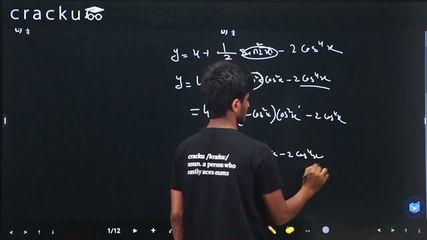
Click on the Email ☝️ to Watch the Video Solution
Create a FREE account and get:
_1.webp)

Educational materials for JEE preparation

Ask our AI anything

AI can make mistakes. Please verify important information.
AI can make mistakes. Please verify important information.
