
Join Our JEE Preparation Group
Prep with like-minded aspirants; Get access to free daily tests and study material.
Sign in
Please select an account to continue using cracku.in
↓ →
Join Our JEE Preparation Group
Prep with like-minded aspirants; Get access to free daily tests and study material.
To determine which compound yields 3-methyl-6-oxoheptanal upon ozonolysis, we reverse the ozonolysis process.
The target product is 3-methyl-6-oxoheptanal, whose structure can be written as
$$CHO-CH_2-CH_2-CH(CH_3)-CH_2-C(=O)-CH_3.$$
The name indicates a seven-carbon chain containing an aldehyde group at C1, a ketone group at C6, and a methyl substituent at C3.
Ozonolysis of an alkene followed by reductive workup ($$O_3$$ followed by $$Zn/H_2O$$) cleaves the carbon-carbon double bond and converts the two alkene carbons into carbonyl groups. Therefore, to identify the original alkene, we reverse the process by joining the two carbonyl carbons with a double bond.
In the given product, the two carbonyl carbons are:
Connecting these two carbons reconstructs the original double bond and produces a six-membered ring. The methyl substituent present at C3 of the product remains attached to the corresponding carbon in the ring, while the methyl group bonded to the ketone carbon remains attached to the alkene carbon.
The resulting structure is 1,4-dimethylcyclohex-1-ene.
Examining the given options, Option B represents 1,4-dimethylcyclohex-1-ene. On ozonolysis, cleavage of its $$C=C$$ bond produces:
This gives the product
$$CHO-CH_2-CH_2-CH(CH_3)-CH_2-C(=O)-CH_3,$$
which is 3-methyl-6-oxoheptanal.
Therefore, the correct answer is Option B.
Was this solution helpful?
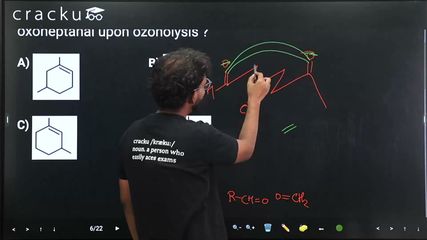
Click on the Email ☝️ to Watch the Video Solution
Create a FREE account and get:
_1.webp)

Educational materials for JEE preparation

Ask our AI anything

AI can make mistakes. Please verify important information.
AI can make mistakes. Please verify important information.


