
Join Our JEE Preparation Group
Prep with like-minded aspirants; Get access to free daily tests and study material.
Sign in
Please select an account to continue using cracku.in
↓ →
Join Our JEE Preparation Group
Prep with like-minded aspirants; Get access to free daily tests and study material.
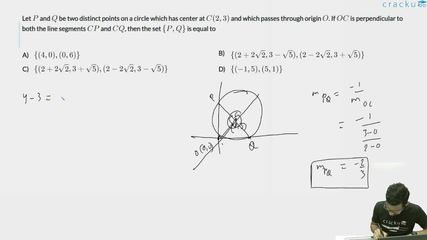
Let $$P$$ and $$Q$$ be two distinct points on a circle which has center at $$C(2, 3)$$ and which passes through origin $$O$$. If $$OC$$ is perpendicular to both the line segments $$CP$$ and $$CQ$$, then the set $$\{P, Q\}$$ is equal to
We are told that the circle has centre $$C(2,\,3)$$ and passes through the origin $$O(0,\,0)$$. Using the distance formula, the radius $$r$$ is
$$r = OC = \sqrt{(2 - 0)^2 + (3 - 0)^2} = \sqrt{4 + 9} = \sqrt{13}.$$
Any point $$P(x,\,y)$$ lying on this circle must therefore satisfy the standard equation
$$CP = r \;\Longrightarrow\; (x - 2)^2 + (y - 3)^2 = 13.$$
We are further told that the line segment $$OC$$ is perpendicular to the line segments $$CP$$ and $$CQ$$. A perpendicularity condition in vector form is
$$\vec{CP}\cdot\vec{CO}=0.$$
Here, $$\vec{CO}$$ is the vector from $$C$$ to $$O$$, so
$$\vec{CO}=O-C=(0-2,\;0-3)=(-2,\,-3).$$
If $$P(x,\,y)$$ is any required point, then $$\vec{CP}=P-C=(x-2,\;y-3).$$ The dot-product condition becomes
$$\bigl(x-2,\;y-3\bigr)\cdot(-2,\,-3)=0.$$
Evaluating the dot product, we get
$$-2(x-2)\;-\;3(y-3)=0 \;\Longrightarrow\; -2x+4-3y+9=0 \;\Longrightarrow\; -2x-3y+13=0.$$
Rearranging, the equation of the line along which both $$P$$ and $$Q$$ must lie is therefore
$$2x + 3y = 13.$$
Because this line is perpendicular to $$OC$$ and passes through the centre $$C(2,\,3)$$, every admissible point must satisfy both the circle equation and this linear equation. To remove one variable, we express $$y$$ from the linear equation:
$$3y = 13 - 2x \;\Longrightarrow\; y = 3 - \dfrac{2}{3}(x-2).$$
Substituting this expression for $$y$$ into the circle equation $$ (x-2)^2 + (y-3)^2 = 13$$, we write
$$ (x-2)^2 + \left[\,3 - \frac{2}{3}(x-2) - 3\right]^2 = 13.$$
The square bracket simplifies because $$3 - 3=0$$, leaving
$$ (x-2)^2 + \left[-\frac{2}{3}(x-2)\right]^2 = 13.$$
First compute each term: $$ (x-2)^2 = (x-2)^2, \qquad \left[-\frac{2}{3}(x-2)\right]^2 = \frac{4}{9}(x-2)^2. $$ Adding them, $$ (x-2)^2 + \frac{4}{9}(x-2)^2 = \left(1+\frac{4}{9}\right)(x-2)^2 = \frac{13}{9}(x-2)^2. $$ Therefore $$ \frac{13}{9}(x-2)^2 = 13. $$ Multiplying both sides by $$\dfrac{9}{13}$$, we obtain $$ (x-2)^2 = 9. $$ Taking square roots, $$ x-2 = \pm 3 \;\Longrightarrow\; x = 2 \pm 3. $$ Hence the two possible $$x$$-coordinates are $$ x_1 = 5, \qquad x_2 = -1. $$
We now find the corresponding $$y$$-coordinates from $$y = 3 - \dfrac{2}{3}(x-2)$$.
For $$x = 5$$: $$ y = 3 - \frac{2}{3}(5-2) = 3 - \frac{2}{3}\times 3 = 3 - 2 = 1, $$ so one point is $$P(5,\,1).$$
For $$x = -1$$: $$ y = 3 - \frac{2}{3}(-1-2) = 3 - \frac{2}{3}\times(-3) = 3 + 2 = 5, $$ so the other point is $$Q(-1,\,5).$$
Thus the required unordered pair of points is
$$\{P,\,Q\} = \{(-1,\,5),\,(5,\,1)\}.$$
Comparing with the given options, this matches Option D.
Hence, the correct answer is Option D.
Was this solution helpful?
Click on the Email ☝️ to Watch the Video Solution
Create a FREE account and get:
_1.webp)

Educational materials for JEE preparation

Ask our AI anything

AI can make mistakes. Please verify important information.
AI can make mistakes. Please verify important information.
