
Join Our JEE Preparation Group
Prep with like-minded aspirants; Get access to free daily tests and study material.
Sign in
Please select an account to continue using cracku.in
↓ →
Join Our JEE Preparation Group
Prep with like-minded aspirants; Get access to free daily tests and study material.
Let
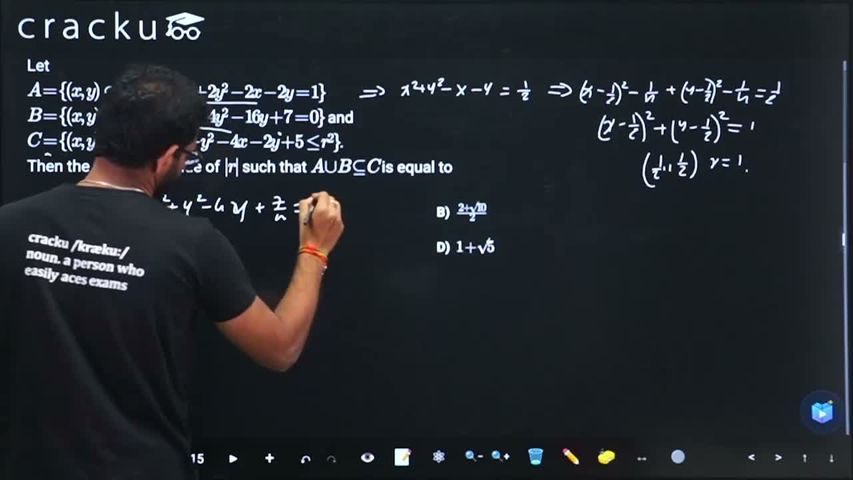
$$A = \{(x, y) \in R \times R \mid 2x^2 + 2y^2 - 2x - 2y = 1\}$$
$$B = \{(x, y) \in R \times R \mid 4x^2 + 4y^2 - 16y + 7 = 0\}$$ and
$$C = \{(x, y) \in R \times R \mid x^2 + y^2 - 4x - 2y + 5 \leq r^2\}$$.
Then the minimum value of $$|r|$$ such that $$A \cup B \subseteq C$$ is equal to
We begin by rewriting each of the three given sets in centre-radius form, because that will allow us to compare their positions in the plane very easily.
For the set $$A$$ we have the equation
$$2x^{2}+2y^{2}-2x-2y=1.$$
Dividing by $$2$$ gives
$$x^{2}+y^{2}-x-y=\frac12.$$
Now we complete the square separately in $$x$$ and $$y$$. The standard identity to remember is
$$u^{2}-2au=(u-a)^{2}-a^{2},$$
so subtracting a first-degree term and then adding (\dfrac14$$ makes a perfect square. Applying this, $$x^{2}-x=\Bigl(x-\tfrac12\Bigr)^{2}-\Bigl(\tfrac12\Bigr)^{2},\qquad y^{2}-y=\Bigl(y-\tfrac12\Bigr)^{2}-\Bigl(\tfrac12\Bigr)^{2}.$$ Therefore $$x^{2}+y^{2}-x-y =\Bigl(x-\tfrac12\Bigr)^{2}+\Bigl(y-\tfrac12\Bigr)^{2} -\Bigl(\tfrac12\Bigr)^{2}-\Bigl(\tfrac12\Bigr)^{2} =\Bigl(x-\tfrac12\Bigr)^{2}+\Bigl(y-\tfrac12\Bigr)^{2}-\frac12.$$ Setting this equal to (\dfrac12$$ gives
$$\Bigl(x-\tfrac12\Bigr)^{2}+\Bigl(y-\tfrac12\Bigr)^{2}=1.$$
Hence $$A$$ is the circle with centre $$\bigl(\tfrac12,\tfrac12\bigr)$$ and radius $$1.$$
For the set $$B$$ we start from
$$4x^{2}+4y^{2}-16y+7=0.$$
Dividing by $$4$$ gives
$$x^{2}+y^{2}-4y+\frac74=0.$$
We complete the square in $$y$$ only (no first-degree term in $$x$$):
$$y^{2}-4y=\bigl(y-2\bigr)^{2}-4.$$
Substituting this,
$$x^{2}+\bigl(y-2\bigr)^{2}-4+\frac74=0 \;\Longrightarrow\; x^{2}+\bigl(y-2\bigr)^{2}=4-\frac74=\frac{16-7}{4}=\frac94.$$
So $$B$$ is the circle with centre $$(0,\,2)$$ and radius $$\sqrt{\tfrac94}=\tfrac32.$$
For the set $$C$$ the inequality is
$$x^{2}+y^{2}-4x-2y+5\le r^{2}.$$
Again we complete the squares. First, for $$x$$:
$$x^{2}-4x=(x-2)^{2}-4,$$
and for $$y$$:
$$y^{2}-2y=(y-1)^{2}-1.$$
Hence
$$x^{2}+y^{2}-4x-2y+5 =(x-2)^{2}-4+(y-1)^{2}-1+5 =(x-2)^{2}+(y-1)^{2}.$$
Thus
$$C=\Bigl\{(x,y)\in\mathbb R^{2}\mid (x-2)^{2}+(y-1)^{2}\le r^{2}\Bigr\},$$
which is the closed disc with centre $$(2,\,1)$$ and radius $$|r|.$$ (Because a radius is non-negative, we may as well write simply $$r\ge0$$.)
Our task is to choose the smallest possible $$r$$ so that every point of $$A\cup B$$ lies inside this disc. Geometrically, that means
$$r=\max\bigl\{\text{distance from }(2,1)\text{ to any point of }A\cup B\bigr\}.$$
For each of the two circles, the farthest point from a fixed external point is obtained by moving from the circle’s centre directly away from the fixed point. Therefore, for a circle with centre $$O_{i}$$ and radius $$\rho_{i},$$ the maximum distance to $$(2,1)$$ is
$$\bigl|O_{i}(2,1)\bigr|+\rho_{i}.$$
We now compute these quantities one by one.
Circle A. Centre $$O_{A}=\bigl(\tfrac12,\tfrac12\bigr).$$ The distance between $$(2,1)$$ and $$O_{A}$$ is
$$\sqrt{(2-\tfrac12)^{2}+(1-\tfrac12)^{2}} =\sqrt{\bigl(\tfrac32\bigr)^{2}+\bigl(\tfrac12\bigr)^{2}} =\sqrt{\frac94+\frac14} =\sqrt{\frac{10}{4}} =\frac{\sqrt{10}}{2}.$$
The radius of circle $$A$$ is $$1,$$ so the farthest point of $$A$$ from $$(2,1)$$ is at a distance
$$d_{A}^{\max}=\frac{\sqrt{10}}{2}+1.$$
Circle B. Centre $$O_{B}=(0,2).$$ The distance between $$(2,1)$$ and $$O_{B}$$ is
$$\sqrt{(2-0)^{2}+(1-2)^{2}}=\sqrt{4+1}=\sqrt5.$$
The radius of circle $$B$$ is $$\tfrac32,$$ hence the farthest point of $$B$$ from $$(2,1)$$ is at a distance
$$d_{B}^{\max}=\sqrt5+\frac32.$$
Between these two numbers, the larger one determines the required radius. Observe that
$$\sqrt5+\frac32 \;-\;\Bigl(\,\frac{\sqrt{10}}{2}+1\Bigr) =\sqrt5+\frac32-\frac{\sqrt{10}}{2}-1 =\Bigl(\sqrt5-\frac{\sqrt{10}}{2}\Bigr)+\frac12 >0,$$
so indeed $$d_{B}^{\max}$$ is the greater. Consequently the minimum value of $$r$$ that works is
$$r_{\min}=d_{B}^{\max}=\sqrt5+\frac32=\frac{3+2\sqrt5}{2}.$$
Because $$r\ge0,$$ we also have $$|r|=r,$$ so
$$\min|r|=\frac{3+2\sqrt5}{2}.$$
Hence, the correct answer is Option C.
Was this solution helpful?
Click on the Email ☝️ to Watch the Video Solution
Create a FREE account and get:
_1.webp)

Educational materials for JEE preparation

Ask our AI anything

AI can make mistakes. Please verify important information.
AI can make mistakes. Please verify important information.
