
Join Our JEE Preparation Group
Prep with like-minded aspirants; Get access to free daily tests and study material.
Sign in
Please select an account to continue using cracku.in
↓ →
Join Our JEE Preparation Group
Prep with like-minded aspirants; Get access to free daily tests and study material.
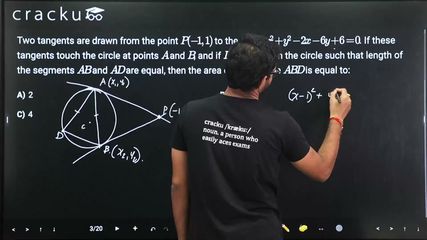
Two tangents are drawn from the point $$P(-1, 1)$$ to the circle $$x^2 + y^2 - 2x - 6y + 6 = 0$$. If these tangents touch the circle at points $$A$$ and $$B$$, and if $$D$$ is a point on the circle such that length of the segments $$AB$$ and $$AD$$ are equal, then the area of the triangle $$ABD$$ is equal to:
First, we rewrite the given circle $$x^{2}+y^{2}-2x-6y+6=0$$ in its centre-radius form. To complete the squares we add and subtract the required constants:
$$x^{2}-2x+1+y^{2}-6y+9+6-1-9=0$$ $$\bigl(x-1\bigr)^{2}+\bigl(y-3\bigr)^{2}-4=0$$ $$\bigl(x-1\bigr)^{2}+\bigl(y-3\bigr)^{2}=4.$$
So the centre of the circle is $$C(1,3)$$ and the radius is $$r=2.$$
The external point from which the tangents are drawn is $$P(-1,1).$$ Using the distance formula, the distance of $$P$$ from the centre $$C$$ is
$$CP=\sqrt{(1-(-1))^{2}+(3-1)^{2}}=\sqrt{2^{2}+2^{2}}=\sqrt{8}=2\sqrt{2}.$$
The length of each tangent drawn from an external point to a circle is given by the formula $$\text{(tangent length)}=\sqrt{CP^{2}-r^{2}}.$$ Substituting $$CP=2\sqrt{2}$$ and $$r=2$$ we obtain
$$PA=PB=\sqrt{(2\sqrt{2})^{2}-2^{2}}=\sqrt{8-4}=\sqrt{4}=2.$$
Let $$A(x_{1},y_{1})$$ and $$B(x_{2},y_{2})$$ be the points of contact. For the circle $$\bigl(x-1\bigr)^{2}+\bigl(y-3\bigr)^{2}=4,$$ the tangent at a point $$(x_{1},y_{1})$$ on the circle is $$(x_{1}-1)(x-1)+(y_{1}-3)(y-3)=4.$$ Since this tangent passes through $$P(-1,1),$$ we substitute:
$$(x_{1}-1)(-1-1)+(y_{1}-3)(1-3)=4,$$ $$-2\bigl[(x_{1}-1)+(y_{1}-3)\bigr]=4,$$ $$(x_{1}-1)+(y_{1}-3)=-2,$$ $$x_{1}+y_{1}=2.$$
Along with the fact that $$A$$ lies on the circle, i.e. $$(x_{1}-1)^{2}+(y_{1}-3)^{2}=4,$$ we solve the system
$$\begin{cases} x_{1}+y_{1}=2,\\ (x_{1}-1)^{2}+(y_{1}-3)^{2}=4. \end{cases}$$
Putting $$y_{1}=2-x_{1}$$ in the second equation,
$$(x_{1}-1)^{2}+(2-x_{1}-3)^{2}=4,$$ $$(x_{1}-1)^{2}+(-1-x_{1})^{2}=4,$$ $$x_{1}^{2}-2x_{1}+1+x_{1}^{2}+2x_{1}+1=4,$$ $$2x_{1}^{2}+2=4,$$ $$x_{1}^{2}=1,$$ $$x_{1}=1\quad\text{or}\quad x_{1}=-1.$$
Corresponding $$y_{1}=2-x_{1}$$ gives
$$A(1,1)\quad\text{and}\quad B(-1,3).$$
The length of chord $$AB$$ is therefore
$$AB=\sqrt{(-1-1)^{2}+(3-1)^{2}}=\sqrt{(-2)^{2}+2^{2}}=\sqrt{8}=2\sqrt{2}.$$
Now we are told that a point $$D$$ on the circle satisfies $$AD=AB=2\sqrt{2}.$$ Let $$D(x,y)$$ be such a point. We require
$$\bigl(x-1\bigr)^{2}+\bigl(y-3\bigr)^{2}=4\quad\text{(because }D\text{ is on the circle)},$$ $$\bigl(x-1\bigr)^{2}+\bigl(y-1\bigr)^{2}=8\quad\text{(because }AD=2\sqrt{2}).$$
Subtracting the first equation from the second eliminates the $$\bigl(x-1\bigr)^{2}$$ term:
$$(y-1)^{2}-(y-3)^{2}=8-4,$$ $$y^{2}-2y+1-\bigl(y^{2}-6y+9\bigr)=4,$$ $$y^{2}-2y+1-y^{2}+6y-9=4,$$ $$4y-8=4,$$ $$4y=12,$$ $$y=3.$$
Substituting $$y=3$$ in the circle equation,
$$(x-1)^{2}=4,$$ $$x-1=\pm2,$$ $$x=3\quad\text{or}\quad x=-1.$$
The point $$(-1,3)$$ is already the point $$B,$$ so the new point is $$D(3,3).$$
Thus the vertices of $$\triangle ABD$$ are $$A(1,1),\;B(-1,3),\;D(3,3).$$
Using the coordinate (shoelace) formula, the area of a triangle with vertices $$(x_{1},y_{1}),\,(x_{2},y_{2}),\,(x_{3},y_{3})$$ is
$$\text{Area}=\frac12\Bigl|x_{1}(y_{2}-y_{3})+x_{2}(y_{3}-y_{1})+x_{3}(y_{1}-y_{2})\Bigr|.$$
Substituting $$A(1,1),\;B(-1,3),\;D(3,3)$$ we get
$$\text{Area}=\frac12\Bigl[\,1(3-3)+(-1)(3-1)+3(1-3)\Bigr]$$ $$=\frac12\bigl[\,0-2-6\bigr]=\frac12(-8)=4.$$
The absolute value has been taken in the last step. Therefore the area of $$\triangle ABD$$ is $$4.$$
Hence, the correct answer is Option C.
Was this solution helpful?
Click on the Email ☝️ to Watch the Video Solution
Create a FREE account and get:
_1.webp)

Educational materials for JEE preparation

Ask our AI anything

AI can make mistakes. Please verify important information.
AI can make mistakes. Please verify important information.
