
Join Our JEE Preparation Group
Prep with like-minded aspirants; Get access to free daily tests and study material.
Sign in
Please select an account to continue using cracku.in
↓ →
Join Our JEE Preparation Group
Prep with like-minded aspirants; Get access to free daily tests and study material.
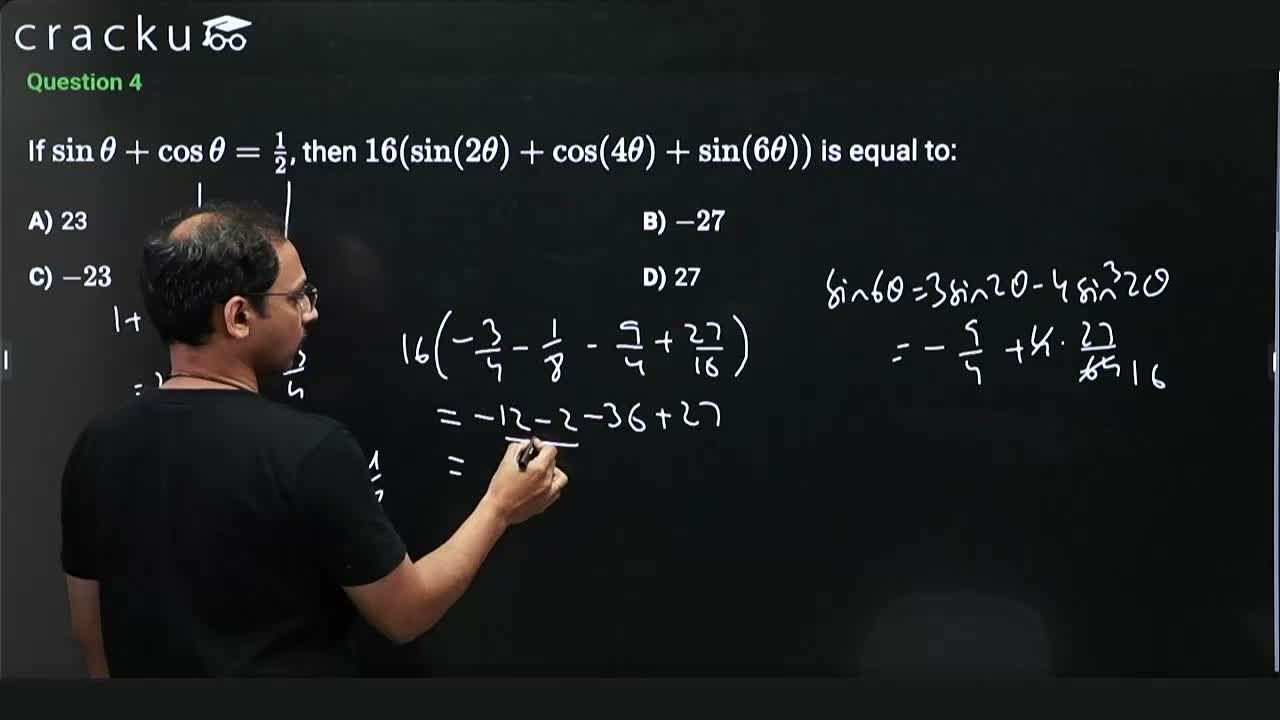
If $$\sin \theta + \cos \theta = \frac{1}{2}$$, then $$16(\sin(2\theta) + \cos(4\theta) + \sin(6\theta))$$ is equal to:
We have been told that $$\sin\theta+\cos\theta=\dfrac12.$$
First, we square both sides. Using the identity $$(a+b)^2=a^2+b^2+2ab,$$ we obtain
$$\left(\sin\theta+\cos\theta\right)^2=\sin^2\theta+\cos^2\theta+2\sin\theta\cos\theta.$$
Because $$\sin^2\theta+\cos^2\theta=1,$$ the right-hand side becomes $$1+2\sin\theta\cos\theta.$$ Therefore
$$\left(\sin\theta+\cos\theta\right)^2=1+2\sin\theta\cos\theta.$$
Substituting the given value $$\sin\theta+\cos\theta=\dfrac12,$$ we get
$$\left(\dfrac12\right)^2=1+2\sin\theta\cos\theta,$$
$$\dfrac14=1+2\sin\theta\cos\theta.$$
So,
$$2\sin\theta\cos\theta=\dfrac14-1=-\dfrac34.$$
The double-angle formula $$\sin2\theta=2\sin\theta\cos\theta$$ now gives
$$\sin2\theta=-\dfrac34.$$
Next, we need $$\cos4\theta.$$ Using the double-angle identity $$\cos2A=1-2\sin^2A,$$ we write
$$\cos4\theta=\cos\bigl(2\cdot2\theta\bigr)=1-2\sin^22\theta.$$
Since $$\sin2\theta=-\dfrac34,$$ we have
$$\sin^22\theta=\left(-\dfrac34\right)^2=\dfrac9{16}.$$
Thus,
$$\cos4\theta=1-2\left(\dfrac9{16}\right)=1-\dfrac{18}{16}=\dfrac{16-18}{16}=-\dfrac18.$$
Now we compute $$\sin6\theta.$$ The angle-addition formula $$\sin(A+B)=\sin A\cos B+\cos A\sin B$$ gives
$$\sin6\theta=\sin\bigl(4\theta+2\theta\bigr)=\sin4\theta\cos2\theta+\cos4\theta\sin2\theta.$$
To use this, we first find $$\cos2\theta.$$ From $$\sin^22\theta+\cos^22\theta=1$$ we get
$$\cos^22\theta=1-\sin^22\theta=1-\dfrac9{16}=\dfrac7{16},$$
$$\cos2\theta=\pm\dfrac{\sqrt7}{4}.$$
We will keep the sign undetermined because the final numerical value will turn out the same in either case.
Using the double-angle identity $$\sin4\theta=2\sin2\theta\cos2\theta,$$ we obtain
$$\sin4\theta=2\left(-\dfrac34\right)\left(\pm\dfrac{\sqrt7}{4}\right)=\mp\dfrac{3\sqrt7}{8}.$$
Now substitute into $$\sin6\theta=\sin4\theta\cos2\theta+\cos4\theta\sin2\theta:$$
$$\sin6\theta=\left(\mp\dfrac{3\sqrt7}{8}\right)\left(\pm\dfrac{\sqrt7}{4}\right)+\left(-\dfrac18\right)\left(-\dfrac34\right).$$
The product of the first pair of signs is negative, so the term simplifies to $$-\dfrac{3\cdot7}{32}=-\dfrac{21}{32}.$$ The second term equals $$\dfrac{3}{32}.$$ Therefore
$$\sin6\theta=-\dfrac{21}{32}+\dfrac{3}{32}=-\dfrac{18}{32}=-\dfrac{9}{16}.$$
We are finally ready to evaluate the required expression:
$$16\left(\sin2\theta+\cos4\theta+\sin6\theta\right)=16\left(-\dfrac34-\dfrac18-\dfrac{9}{16}\right).$$
Convert everything to a common denominator $$16:$$
$$-\dfrac34=-\dfrac{12}{16},\quad -\dfrac18=-\dfrac{2}{16},\quad -\dfrac{9}{16}=-\dfrac{9}{16}.$$
Adding these gives
$$-\dfrac{12}{16}-\dfrac{2}{16}-\dfrac{9}{16}=-\dfrac{23}{16}.$$
Multiplying by $$16$$, we obtain
$$16\left(-\dfrac{23}{16}\right)=-23.$$
Hence, the correct answer is Option C.
Was this solution helpful?
Click on the Email ☝️ to Watch the Video Solution
Create a FREE account and get:
_1.webp)

Educational materials for JEE preparation

Ask our AI anything

AI can make mistakes. Please verify important information.
AI can make mistakes. Please verify important information.
