
Join Our JEE Preparation Group
Prep with like-minded aspirants; Get access to free daily tests and study material.
Sign in
Please select an account to continue using cracku.in
↓ →
Join Our JEE Preparation Group
Prep with like-minded aspirants; Get access to free daily tests and study material.
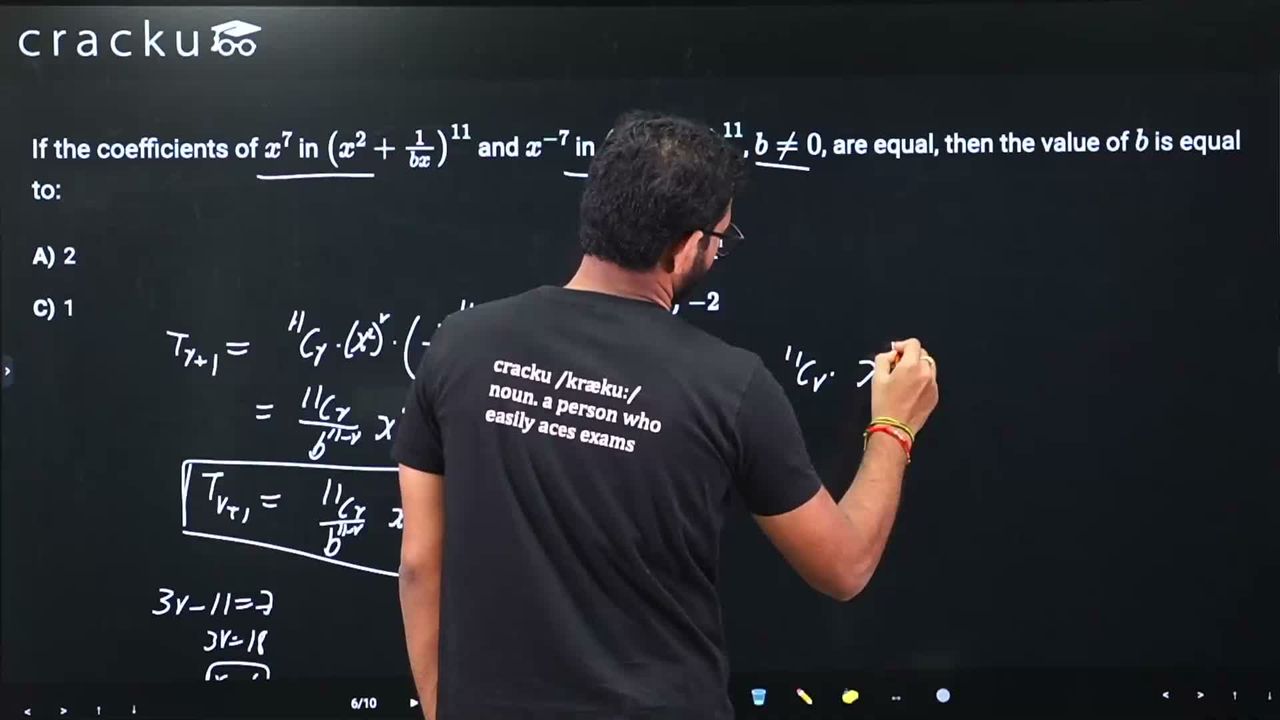
If the coefficients of $$x^7$$ in $$\left(x^2 + \frac{1}{bx}\right)^{11}$$ and $$x^{-7}$$ in $$\left(x - \frac{1}{bx^2}\right)^{11}$$, $$b \neq 0$$, are equal, then the value of $$b$$ is equal to:
We have to compare the coefficient of $$x^{7}$$ in the expansion $$\left(x^{2}+\dfrac{1}{bx}\right)^{11}$$ with the coefficient of $$x^{-7}$$ in the expansion $$\left(x-\dfrac{1}{bx^{2}}\right)^{11}$$, where $$b \neq 0$$.
First we consider $$\left(x^{2}+\dfrac{1}{bx}\right)^{11}$$. For a binomial of the form $$(A+B)^{n}$$, the general term is given by the Binomial Theorem: $$T_{r}=\binom{n}{r}A^{r}B^{\,n-r}.$$ Here, $$A=x^{2},\;B=\dfrac{1}{bx},\;n=11.$$
So the general term is $$T_{r}=\binom{11}{r}\left(x^{2}\right)^{r}\left(\dfrac{1}{bx}\right)^{11-r}.$$ Now we simplify the powers of $$x$$:
$$T_{r}=\binom{11}{r}x^{2r}\left(\dfrac{1}{b}\right)^{11-r}x^{-(11-r)} =\binom{11}{r}\left(\dfrac{1}{b}\right)^{11-r}x^{\,2r-(11-r)} =\binom{11}{r}\left(\dfrac{1}{b}\right)^{11-r}x^{\,3r-11}.$$
We need the exponent of $$x$$ to be $$7$$, so we set $$3r-11=7 \;\;\Longrightarrow\;\; 3r=18 \;\;\Longrightarrow\;\; r=6.$$
Substituting $$r=6$$ in the coefficient we obtain $$\text{Coefficient of }x^{7}= \binom{11}{6}\left(\dfrac{1}{b}\right)^{5}.$$ Since $$\binom{11}{6}=462$$, this coefficient becomes $$\dfrac{462}{b^{5}}.$$
Now we turn to $$\left(x-\dfrac{1}{bx^{2}}\right)^{11}$$. Again, using the Binomial Theorem with $$A=x,\;B=-\dfrac{1}{bx^{2}},\;n=11$$, the general term is
$$T_{r}=\binom{11}{r}x^{r}\left(-\dfrac{1}{bx^{2}}\right)^{11-r} =\binom{11}{r}x^{r}(-1)^{11-r}\left(\dfrac{1}{b}\right)^{11-r}x^{-2(11-r)}.$$
Combining the powers of $$x$$ we get $$T_{r}=\binom{11}{r}(-1)^{11-r}\left(\dfrac{1}{b}\right)^{11-r}x^{\,r-2(11-r)} =\binom{11}{r}(-1)^{11-r}\left(\dfrac{1}{b}\right)^{11-r}x^{\,r-22+2r} =\binom{11}{r}(-1)^{11-r}\left(\dfrac{1}{b}\right)^{11-r}x^{\,3r-22}.$$
We require the exponent of $$x$$ to be $$-7$$, hence $$3r-22=-7 \;\;\Longrightarrow\;\; 3r=15 \;\;\Longrightarrow\;\; r=5.$$
Substituting $$r=5$$ in the coefficient gives $$\text{Coefficient of }x^{-7}= \binom{11}{5}(-1)^{6}\left(\dfrac{1}{b}\right)^{6}.$$ Because $$(-1)^{6}=1$$ and $$\binom{11}{5}=462$$, this coefficient equals $$\dfrac{462}{b^{6}}.$$
The problem states that these two coefficients are equal, so we set
$$\dfrac{462}{b^{5}}=\dfrac{462}{b^{6}}.$$
Cancelling the common factor $$462$$ and cross-multiplying, we obtain
$$b^{6}=b^{5}\;\;\Longrightarrow\;\; b^{6}-b^{5}=0\;\;\Longrightarrow\;\; b^{5}(b-1)=0.$$
Since $$b\neq 0$$, the factor $$b^{5}$$ cannot be zero, leaving
$$b-1=0\;\;\Longrightarrow\;\; b=1.$$
Hence, the correct answer is Option C.
Was this solution helpful?
Click on the Email ☝️ to Watch the Video Solution
Create a FREE account and get:
_1.webp)

Educational materials for JEE preparation

Ask our AI anything

AI can make mistakes. Please verify important information.
AI can make mistakes. Please verify important information.
