
Join Our JEE Preparation Group
Prep with like-minded aspirants; Get access to free daily tests and study material.
Sign in
Please select an account to continue using cracku.in
↓ →
Join Our JEE Preparation Group
Prep with like-minded aspirants; Get access to free daily tests and study material.
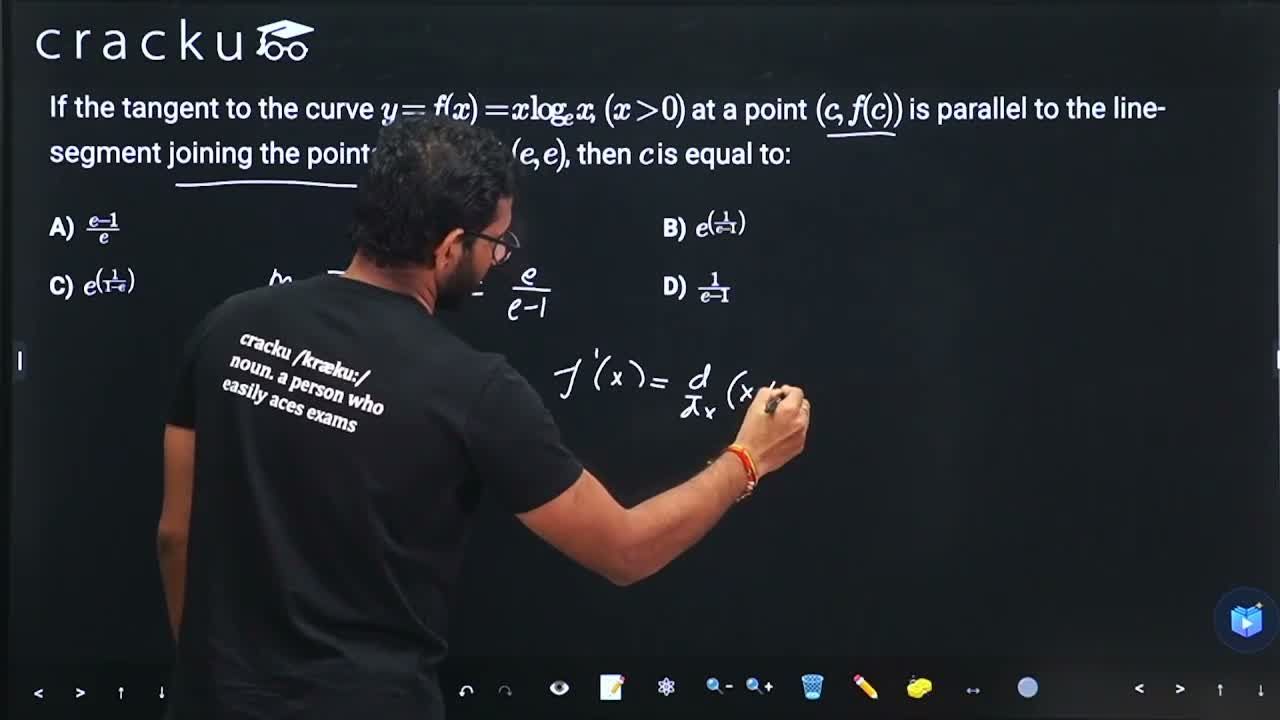
If the tangent to the curve $$y = f(x) = x\log_e x$$, $$(x > 0)$$ at a point $$(c, f(c))$$ is parallel to the line-segment joining the points $$(1, 0)$$ and $$(e, e)$$, then $$c$$ is equal to:
We are given two geometric conditions that are parallel to each other. According to coordinate geometry, parallel lines must have exactly equal slopes.
First, let us calculate the slope of the line-segment joining the two given points $$(1, 0)$$ and $$(e, e)$$. Using the standard two-point slope formula:
$$\text{Slope } m = \frac{y_2 - y_1}{x_2 - x_1} = \frac{e - 0}{e - 1} = \frac{e}{e - 1}$$
Second, we need to find the slope of the tangent to the given curve at the variable point $$x = c$$. The slope of a tangent line is equal to the first derivative of the function evaluated at that specific point.
The equation of our curve is:
$$f(x) = x\log_e x$$
Let us calculate the derivative with respect to $$x$$ by applying the product rule of differentiation:
$$\frac{df}{dx} = \frac{d}{dx}[x] \cdot \log_e x + x \cdot \frac{d}{dx}[\log_e x]$$
$$\frac{df}{dx} = 1 \cdot \log_e x + x \cdot \left(\frac{1}{x}\right) = \log_e x + 1$$
Now, we evaluate this derivative at the point where $$x = c$$ to get the explicit slope of our tangent line:
$$\text{Slope of the tangent} = \log_e c + 1$$
Since the tangent line is parallel to the line-segment connecting the two points, we equate their respective slopes:
$$\log_e c + 1 = \frac{e}{e - 1}$$
Subtract 1 from both sides of the equation to isolate the logarithmic term:
$$\log_e c = \frac{e}{e - 1} - 1$$
Combine the terms on the right side over a single common denominator:
$$\log_e c = \frac{e - (e - 1)}{e - 1} = \frac{e - e + 1}{e - 1} = \frac{1}{e - 1}$$
To solve for the base coordinate variable $$c$$, we convert the logarithmic equation into its equivalent exponential form:
$$c = e^{\frac{1}{e-1}}$$
Was this solution helpful?
Click on the Email ☝️ to Watch the Video Solution
Create a FREE account and get:
_1.webp)

Educational materials for JEE preparation

Ask our AI anything

AI can make mistakes. Please verify important information.
AI can make mistakes. Please verify important information.
