
Join Our JEE Preparation Group
Prep with like-minded aspirants; Get access to free daily tests and study material.
Sign in
Please select an account to continue using cracku.in
↓ →
Join Our JEE Preparation Group
Prep with like-minded aspirants; Get access to free daily tests and study material.
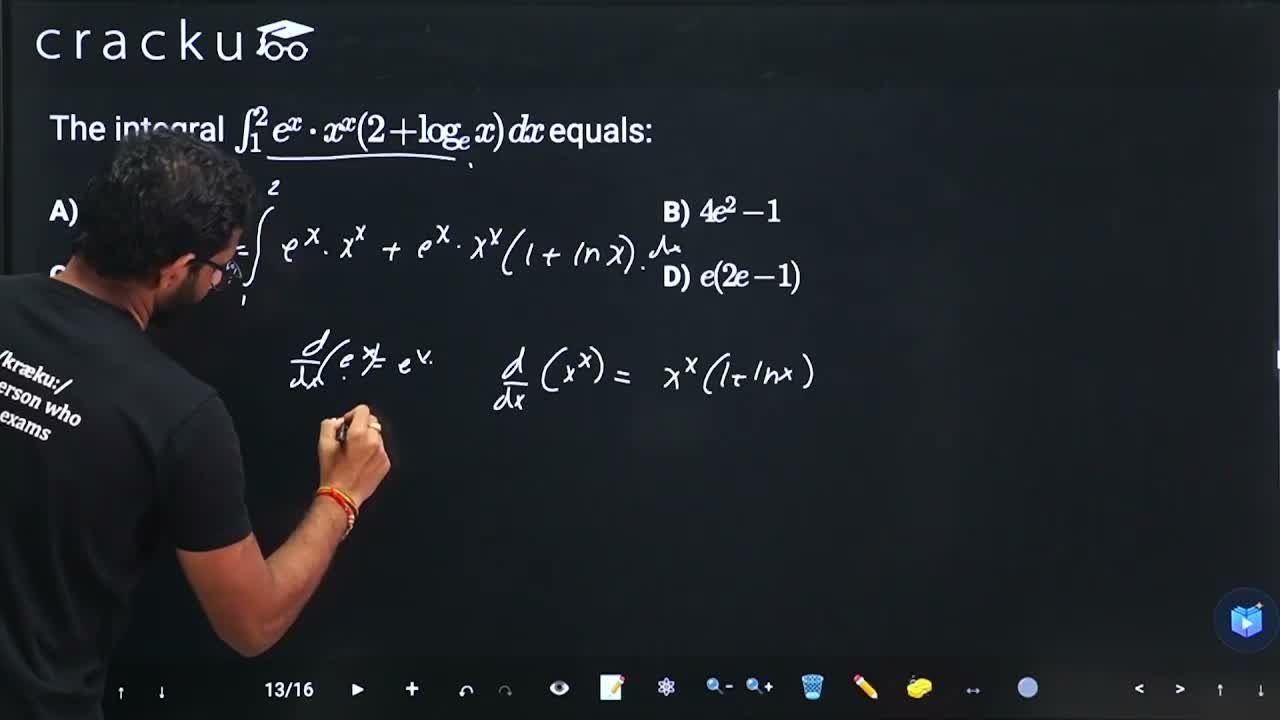
First we observe the integrand carefully. We have to evaluate the definite integral
$$I=\int_{1}^{2} e^{x}\,x^{x}\,(2+\log_{e}x)\,dx.$$
Whenever a product of two familiar functions appears together with a linear expression in $$\log_{e}x$$, it is often useful to check if this product is the derivative of some simpler‐looking expression. With that idea in mind, let us define
$$F(x)=e^{x}\,x^{x}.$$
We shall now differentiate $$F(x)$$ with respect to $$x$$. We will need the following two facts:
• The derivative of the exponential function is itself, that is $$\dfrac{d}{dx}\bigl(e^{x}\bigr)=e^{x}.$$
• The derivative of the special power function $$x^{x}$$. Using the logarithmic differentiation rule we first write $$x^{x}=e^{x\log_{e}x}$$ and then differentiate: $$\dfrac{d}{dx}\bigl(x^{x}\bigr)=x^{x}\left(\log_{e}x+1\right).$$
Now we apply the product rule of differentiation, which states $$\dfrac{d}{dx}\bigl(u\cdot v\bigr)=u^{\prime}v+uv^{\prime}.$$ Taking $$u=e^{x}$$ and $$v=x^{x}$$, we get
$$\begin{aligned} F^{\prime}(x) &=\dfrac{d}{dx}\bigl(e^{x}\bigr)\cdot x^{x}+e^{x}\cdot\dfrac{d}{dx}\bigl(x^{x}\bigr)\\[4pt] &=e^{x}\,x^{x}+e^{x}\,x^{x}\left(\log_{e}x+1\right)\\[4pt] &=e^{x}\,x^{x}\Bigl[1+\bigl(\log_{e}x+1\bigr)\Bigr]\\[4pt] &=e^{x}\,x^{x}\bigl(\log_{e}x+2\bigr). \end{aligned}$$
Notice that the bracket $$\bigl(\log_{e}x+2\bigr)$$ is exactly the same as $$\,(2+\log_{e}x)\,.$$ Therefore we can write
$$F^{\prime}(x)=e^{x}\,x^{x}\,(2+\log_{e}x).$$
This shows that our original integrand is precisely the derivative $$F^{\prime}(x).$$ Hence, by the Fundamental Theorem of Calculus, we can integrate immediately:
$$\begin{aligned} I&=\int_{1}^{2}F^{\prime}(x)\,dx\\[4pt] &=F(2)-F(1). \end{aligned}$$
Let us now substitute the definition $$F(x)=e^{x}\,x^{x}.$$ We have
$$F(2)=e^{2}\cdot2^{2}=e^{2}\cdot4=4e^{2},$$
and
$$F(1)=e^{1}\cdot1^{1}=e\cdot1=e.$$
Therefore,
$$\begin{aligned} I&=F(2)-F(1)\\[4pt] &=4e^{2}-e. \end{aligned}$$
This result can be factorised to see it in the same form as the given options:
$$4e^{2}-e=e\,(4e-1).$$
The expression $$e\,(4e-1)$$ corresponds to Option C.
Hence, the correct answer is Option C.
Was this solution helpful?
Click on the Email ☝️ to Watch the Video Solution
Create a FREE account and get:
_1.webp)

Educational materials for JEE preparation

Ask our AI anything

AI can make mistakes. Please verify important information.
AI can make mistakes. Please verify important information.


