
Join Our JEE Preparation Group
Prep with like-minded aspirants; Get access to free daily tests and study material.
Sign in
Please select an account to continue using cracku.in
↓ →
Join Our JEE Preparation Group
Prep with like-minded aspirants; Get access to free daily tests and study material.
If $$\sin^4 \alpha + 4\cos^4 \beta + 2 = 4\sqrt{2} \sin\alpha \cos\beta$$, $$\alpha, \beta \in [0, \pi]$$, then $$\cos(\alpha + \beta) - \cos(\alpha - \beta)$$ is equal to
We are given the equality
$$\sin^4\alpha + 4\cos^4\beta + 2 = 4\sqrt2\;\sin\alpha\cos\beta\,,\qquad \alpha,\,\beta\in[0,\pi].$$
Because $$\sin\alpha\ge 0$$ for every $$\alpha\in[0,\pi],$$ we set
$$\sin\alpha=\sqrt{s}\quad(s\ge 0),\qquad \cos\beta = C\quad(C\in[-1,1]).$$
Then $$s=\sin^2\alpha\in[0,1]$$ and $$C^2=\cos^2\beta\in[0,1].$$ Substituting these symbols in the given equation we obtain
$$s^2 + 4C^4 + 2 = 4\sqrt2\,\sqrt{s}\,C. \quad -(1)$$
The sign of the right-hand side is the sign of $$C$$. The left-hand side is clearly positive. Hence $$C$$ must be non-negative, i.e. $$C\ge 0\;(0\le\beta\le\pi/2).$$ Therefore we can write $$C=\sqrt{c}\,(c=C^2).$$ It is more convenient to remove the radicals completely, so we introduce two new non-negative variables
$$v=\sqrt{s}=\sin\alpha,\qquad u=\sqrt2\,C=\sqrt2\,\cos\beta.$$
Because $$0\le s\le 1$$ and $$0\le C\le 1,$$ we have $$0\le v\le 1,\;0\le u\le\sqrt2.$$ Now (1) becomes
$$v^4+u^4+2=4uv. \quad -(2)$$
To analyse (2) we separate two non-negative parts.
First write
$$v^4+u^4=(v^2-u^2)^2+2v^2u^2,$$ so that
$$(2)\;\Longrightarrow\;(v^2-u^2)^2+2v^2u^2+2-4uv=0. \quad -(3)$$
We now estimate the second bracket in (3) with the Arithmetic-Geometric Mean inequality. For any non-negative numbers $$x,y$$ we have $$\dfrac{x+1}{2}\ge\sqrt{x}.$$ Putting $$x=v^2u^2$$ yields
$$v^2u^2+1\;\ge\;2vu\quad\Longrightarrow\quad 2v^2u^2+2\;\ge\;4vu.$$
Hence
$$2v^2u^2+2-4vu\;\ge\;0.$$
Both summands in (3) are therefore non-negative, and their sum equals zero. Consequently each must vanish.
1. $$(v^2-u^2)^2=0\;\Longrightarrow\;v^2=u^2\;\Longrightarrow\;v=u.$$
2. $$2v^2u^2+2-4vu=0\;\Longrightarrow\;v^2u^2+1=2vu.$$ Substituting $$u=v$$ from step 1 we get $$v^4+1=2v^2\;\Longrightarrow\;(v^2-1)^2=0\;\Longrightarrow\;v=1.$$
Thus
$$v=1,\qquad u=1.$$ Reverting to the original trigonometric quantities, we have
$$\sin\alpha=v=1\;\Longrightarrow\;\alpha=\dfrac{\pi}{2},$$
$$\sqrt2\,\cos\beta=u=1\;\Longrightarrow\;\cos\beta=\dfrac1{\sqrt2}\; \Longrightarrow\;\beta=\dfrac{\pi}{4}.$$
Now we evaluate the required expression. First state the identity that will be used:
$$\cos(A+B)-\cos(A-B)=-2\sin A\sin B.$$
Using $$A=\alpha,\;B=\beta$$ together with $$\sin\alpha=1,\;\sin\beta=\dfrac1{\sqrt2},$$ we get
$$\cos(\alpha+\beta)-\cos(\alpha-\beta)= -2\sin\alpha\sin\beta =-2\left(1\right)\left(\dfrac1{\sqrt2}\right)=-\sqrt2.$$
Hence, the correct answer is Option B.
Was this solution helpful?
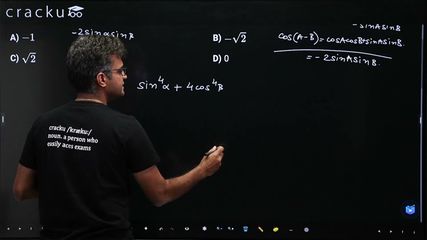
Click on the Email ☝️ to Watch the Video Solution
Create a FREE account and get:
_1.webp)

Educational materials for JEE preparation

Ask our AI anything

AI can make mistakes. Please verify important information.
AI can make mistakes. Please verify important information.


