
Join Our JEE Preparation Group
Prep with like-minded aspirants; Get access to free daily tests and study material.
Sign in
Please select an account to continue using cracku.in
↓ →
Join Our JEE Preparation Group
Prep with like-minded aspirants; Get access to free daily tests and study material.
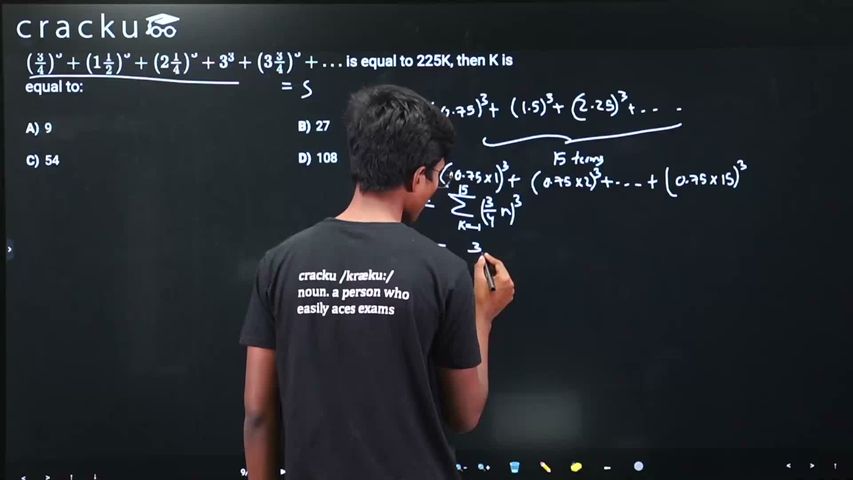
If the sum of the first 15 terms of the series $$\left(\frac{3}{4}\right)^3 + \left(1\frac{1}{2}\right)^3 + \left(2\frac{1}{4}\right)^3 + 3^3 + \left(3\frac{3}{4}\right)^3 + \ldots$$ is equal to 225K, then K is equal to:
The given series begins as
$$\left(\frac34\right)^3 + \left(1\frac12\right)^3 + \left(2\frac14\right)^3 + 3^3 + \left(3\frac34\right)^3 + \ldots$$
First we write every mixed fraction as an ordinary fraction or decimal so that the pattern is clear:
$$\frac34, \; 1\frac12 = \frac32, \; 2\frac14 = \frac94, \; 3 = 3, \; 3\frac34 = \frac{15}4, \ldots$$
Numerically these are
$$0.75,\;1.5,\;2.25,\;3,\;3.75,\; \ldots$$
We observe that each successive base increases by $$0.75=\frac34$$. Hence the un-cubed terms form an arithmetic progression with
first term $$a = 0.75=\frac34,$$
common difference $$d = 0.75=\frac34.$$
Therefore the $$n^{\text{th}}$$ base before cubing is obtained from the standard A.P. formula $$a_n = a + (n-1)d.$$ Substituting $$a=\frac34$$ and $$d=\frac34,$$ we get
$$a_n = \frac34 + (n-1)\frac34 = \frac34\,n.$$
Each actual term of the series is the cube of this base, so the $$n^{\text{th}}$$ term $$T_n$$ equals
$$T_n = \left(\frac34\,n\right)^3 = \frac{27}{64}\,n^3.$$
We require the sum of the first 15 terms, i.e.
$$S_{15} = \sum_{n=1}^{15} T_n = \sum_{n=1}^{15} \frac{27}{64}\,n^3.$$
The constant factor $$\frac{27}{64}$$ can be taken outside the summation:
$$S_{15} = \frac{27}{64}\,\sum_{n=1}^{15} n^3.$$
Now we use the well-known formula for the sum of the cubes of the first $$N$$ natural numbers, stated as
$$\sum_{n=1}^{N} n^3 = \left[\frac{N(N+1)}{2}\right]^2.$$
Putting $$N = 15$$ we obtain
$$\sum_{n=1}^{15} n^3 = \left[\frac{15\cdot16}{2}\right]^2 = (120)^2 = 14400.$$
Substituting this value into the expression for $$S_{15}$$ gives
$$S_{15} = \frac{27}{64}\times14400.$$
We simplify step by step. First divide $$14400$$ by $$64$$:
$$\frac{14400}{64} = 225.$$
So
$$S_{15} = 27 \times 225.$$
Next multiply:
$$27 \times 225 = 27 \times (200 + 25) = 27\cdot200 + 27\cdot25 = 5400 + 675 = 6075.$$
Therefore
$$S_{15} = 6075.$$
According to the question, this sum equals $$225K$$, that is
$$225K = 6075.$$
Solving for $$K$$ by dividing both sides by $$225$$, we have
$$K = \frac{6075}{225}.$$
Since $$225 \times 27 = 6075$$, the division yields
$$K = 27.$$
Hence, the correct answer is Option B.
Was this solution helpful?
Click on the Email ☝️ to Watch the Video Solution
Create a FREE account and get:
_1.webp)

Educational materials for JEE preparation

Ask our AI anything

AI can make mistakes. Please verify important information.
AI can make mistakes. Please verify important information.


