
Join Our JEE Preparation Group
Prep with like-minded aspirants; Get access to free daily tests and study material.
Sign in
Please select an account to continue using cracku.in
↓ →
Join Our JEE Preparation Group
Prep with like-minded aspirants; Get access to free daily tests and study material.
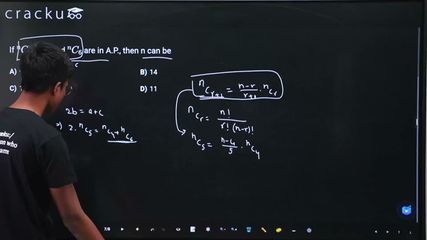
We have been told that the three binomial coefficients $$^nC_4,\; ^nC_5,\; ^nC_6$$ form an arithmetic progression. In an arithmetic progression the middle term is the average of its neighbours, so the defining condition is
$$2\,^nC_5 \;=\; ^nC_4 + ^nC_6.$$
First recall the factorial form of a binomial coefficient:
$$^nC_r \;=\; \dfrac{n!}{r!\,(n-r)!}.$$
There is also a very convenient ratio formula derived straight from the factorial definition:
$$^nC_{\,r+1} \;=\; \dfrac{n-r}{r+1}\; ^nC_r.$$ This will allow us to rewrite every term in the above equation in terms of the single quantity $$^nC_5$$.
To express $$^nC_4$$ in terms of $$^nC_5$$ we set $$r=4$$ in the ratio formula and obtain
$$^nC_5 \;=\; \dfrac{n-4}{5}\; ^nC_4 \;\;\Longrightarrow\;\; ^nC_4 \;=\; ^nC_5 \;\dfrac{5}{\,n-4}.$$
Next, to express $$^nC_6$$ in terms of $$^nC_5$$ we set $$r=5$$ in the same ratio formula and get
$$^nC_6 \;=\; \dfrac{n-5}{6}\; ^nC_5.$$
Now substitute these two expressions into the arithmetic-progression condition:
$$2\,^nC_5 \;=\; ^nC_5\,\dfrac{5}{n-4} \;+\; ^nC_5\,\dfrac{n-5}{6}.$$
Because $$^nC_5$$ is a common, non-zero factor, we may divide both sides by it:
$$2 \;=\; \dfrac{5}{n-4} \;+\; \dfrac{n-5}{6}.$$
To clear the denominators multiply every term by $$6\,(n-4):$$
$$2 \times 6\,(n-4) \;=\; 5 \times 6 \;+\; (n-5)\,(n-4).$$
Simplifying the left-hand side:
$$12\,(n-4).$$
Simplifying the right-hand side step by step gives
$$30 + (n-5)(n-4).$$
Expanding the product $$(n-5)(n-4)$$:
$$n^2 - 4n - 5n + 20 \;=\; n^2 - 9n + 20.$$
So the equation becomes
$$12(n-4) \;=\; 30 + n^2 - 9n + 20.$$
Combine the constants on the right:
$$12(n-4) \;=\; n^2 - 9n + 50.$$
Expand the left-hand side:
$$12n - 48 \;=\; n^2 - 9n + 50.$$
Now bring every term to the right to obtain a standard quadratic equation:
$$0 \;=\; n^2 - 9n + 50 - 12n + 48,$$
which simplifies to
$$n^2 - 21n + 98 \;=\; 0.$$
We solve this quadratic by the discriminant method. The discriminant is
$$\Delta \;=\; (-21)^2 - 4 \times 1 \times 98 \;=\; 441 - 392 \;=\; 49.$$
Since $$\sqrt{\Delta}=7,$$ the roots are
$$n \;=\; \dfrac{21 \pm 7}{2}.$$
This gives the two numerical values
$$n_1 = \dfrac{21 + 7}{2} = \dfrac{28}{2} = 14,$$ $$n_2 = \dfrac{21 - 7}{2} = \dfrac{14}{2} = 7.$$
Both numbers are indeed > 6, so both satisfy the algebraic condition. However, among the options offered (9, 14, 12, 11) only $$14$$ appears. Consequently the permissible value of $$n$$ from the given list is $$14$$.
Hence, the correct answer is Option B.
Was this solution helpful?
Click on the Email ☝️ to Watch the Video Solution
Create a FREE account and get:
_1.webp)

Educational materials for JEE preparation

Ask our AI anything

AI can make mistakes. Please verify important information.
AI can make mistakes. Please verify important information.


