
Join Our JEE Preparation Group
Prep with like-minded aspirants; Get access to free daily tests and study material.
Sign in
Please select an account to continue using cracku.in
↓ →
Join Our JEE Preparation Group
Prep with like-minded aspirants; Get access to free daily tests and study material.
The total number of irrational terms in the binomial expansion of $$\left(7^{1/5} - 3^{1/10}\right)^{60}$$ is
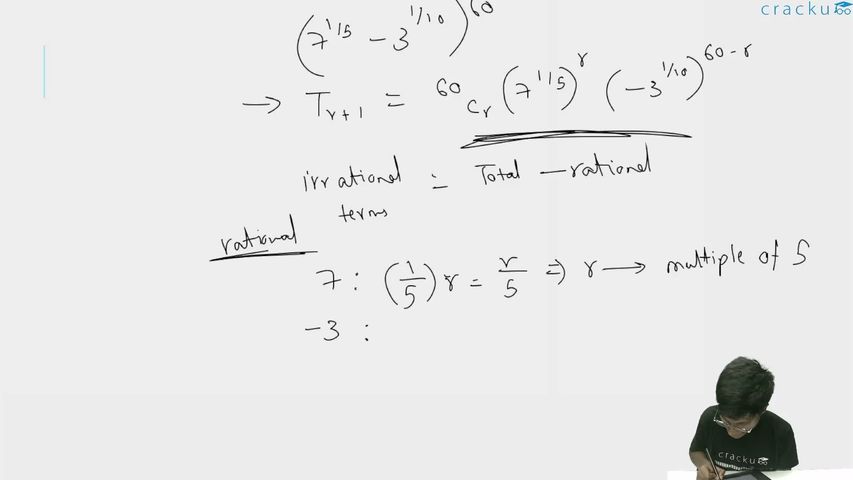
We begin with the binomial expression $$\left(7^{1/5}-3^{1/10}\right)^{60}.$$ According to the binomial theorem, which states that for any real numbers $$a$$ and $$b$$ and a non-negative integer $$n$$ we have $$\left(a+b\right)^n=\sum_{k=0}^{n}\binom{n}{k}a^{\,n-k}b^{\,k},$$ the general term of the expansion of $$\left(7^{1/5}-3^{1/10}\right)^{60}$$ is obtained by setting $$a=7^{1/5},\;b=-3^{1/10},\;n=60.$$
So the $$(k+1)\text{-th}$$ term (with $$k$$ starting from $$0$$) is
$$T_{k+1}=\binom{60}{k}\left(7^{1/5}\right)^{60-k}\left(-3^{1/10}\right)^{k}.$$
We separate the sign factor $${(-1)}^{k}$$ and write the powers of $$7$$ and $$3$$ explicitly:
$$T_{k+1}=(-1)^{k}\binom{60}{k}\;7^{\,(60-k)/5}\;3^{\,k/10}.$$
For the term $$T_{k+1}$$ to be rational, both exponents $$\dfrac{60-k}{5}$$ and $$\dfrac{k}{10}$$ must be whole numbers, because $$7^{\text{integer}}\times3^{\text{integer}}$$ is an integer (apart from the possible sign) and therefore rational.
First we impose the condition
$$\frac{k}{10}\in\mathbb{Z}\quad\Longrightarrow\quad k\text{ must be divisible by }10.$$
Within the range $$0\le k\le60,$$ the values of $$k$$ satisfying this requirement are $$k=0,\,10,\,20,\,30,\,40,\,50,\,60.$$
Next we check the second condition
$$\frac{60-k}{5}\in\mathbb{Z}\quad\Longrightarrow\quad60-k\text{ must be divisible by }5.$$
If $$k$$ is already a multiple of $$10,$$ then $$60-k$$ is automatically a multiple of $$5$$ (because subtracting a multiple of $$10$$ from $$60$$ leaves a number ending in $$0$$, which is divisible by $$5$$). Thus every one of the above $$k$$-values satisfies the second condition as well.
Therefore, exactly the following $$7$$ terms are rational:
$$k=0,\;10,\;20,\;30,\;40,\;50,\;60.$$
The total number of terms in a binomial expansion with exponent $$60$$ is $$60+1=61.$$
Hence the number of irrational terms is obtained by subtracting the $$7$$ rational terms from the total number of terms:
$$\text{Number of irrational terms}=61-7=54.$$
Hence, the correct answer is Option C.
Was this solution helpful?
Click on the Email ☝️ to Watch the Video Solution
Create a FREE account and get:
_1.webp)

Educational materials for JEE preparation

Ask our AI anything

AI can make mistakes. Please verify important information.
AI can make mistakes. Please verify important information.


