
Join Our JEE Preparation Group
Prep with like-minded aspirants; Get access to free daily tests and study material.
Sign in
Please select an account to continue using cracku.in
↓ →
Join Our JEE Preparation Group
Prep with like-minded aspirants; Get access to free daily tests and study material.
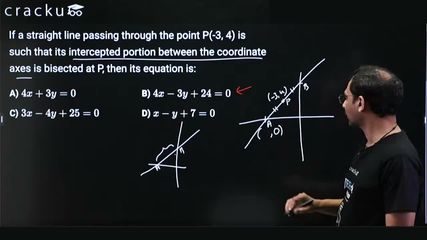
If a straight line passing through the point P(-3, 4) is such that its intercepted portion between the coordinate axes is bisected at P, then its equation is:
We have a straight line that cuts the coordinate axes at two points: let the x-intercept be $$A(a,0)$$ and the y-intercept be $$B(0,b)$$. In coordinate geometry, the equation of such a line in “intercept form” is first stated as
$$\frac{x}{a}+\frac{y}{b}=1.$$
The problem states that the fixed point $$P(-3,4)$$ lies on the line and, moreover, that the segment $$AB$$ is bisected at $$P$$. To translate “bisected at $$P$$”, we recall the mid-point formula: if $$M(x_m, y_m)$$ is the midpoint of $$A(x_1,y_1)$$ and $$B(x_2,y_2)$$, then
$$x_m=\frac{x_1+x_2}{2},\qquad y_m=\frac{y_1+y_2}{2}.$$
Applying this to $$A(a,0)$$ and $$B(0,b)$$ with midpoint $$P(-3,4)$$, we write
$$\frac{a+0}{2}=-3,\qquad\frac{0+b}{2}=4.$$
Solving these two simple equations one by one:
First, $$\dfrac{a}{2}=-3 \;\Longrightarrow\; a=-6.$$
Second, $$\dfrac{b}{2}=4 \;\Longrightarrow\; b=8.$$
So the line meets the x-axis at $$(-6,0)$$ and the y-axis at $$(0,8)$$. We now substitute these values of $$a$$ and $$b$$ back into the intercept form of the line.
Starting with $$\dfrac{x}{a}+\dfrac{y}{b}=1$$ and inserting $$a=-6$$, $$b=8$$, we get
$$\frac{x}{-6}+\frac{y}{8}=1.$$
To clear the denominators, multiply both sides by the LCM $$24$$:
$$24\left(\frac{x}{-6}\right)+24\left(\frac{y}{8}\right)=24(1).$$
Simplifying term by term,
$$24\left(\frac{x}{-6}\right)=-4x,\qquad 24\left(\frac{y}{8}\right)=3y,\qquad 24(1)=24.$$
So the equation becomes
$$-4x+3y=24.$$
For a tidier appearance—and to match one of the given options—we multiply through by $$-1$$:
$$4x-3y=-24.$$
Finally, bringing all terms to the left-hand side gives the standard form
$$4x-3y+24=0.$$
Hence, the correct answer is Option B.
Was this solution helpful?
Click on the Email ☝️ to Watch the Video Solution
Create a FREE account and get:
_1.webp)

Educational materials for JEE preparation

Ask our AI anything

AI can make mistakes. Please verify important information.
AI can make mistakes. Please verify important information.


