
Join Our JEE Preparation Group
Prep with like-minded aspirants; Get access to free daily tests and study material.
Sign in
Please select an account to continue using cracku.in
↓ →
Join Our JEE Preparation Group
Prep with like-minded aspirants; Get access to free daily tests and study material.
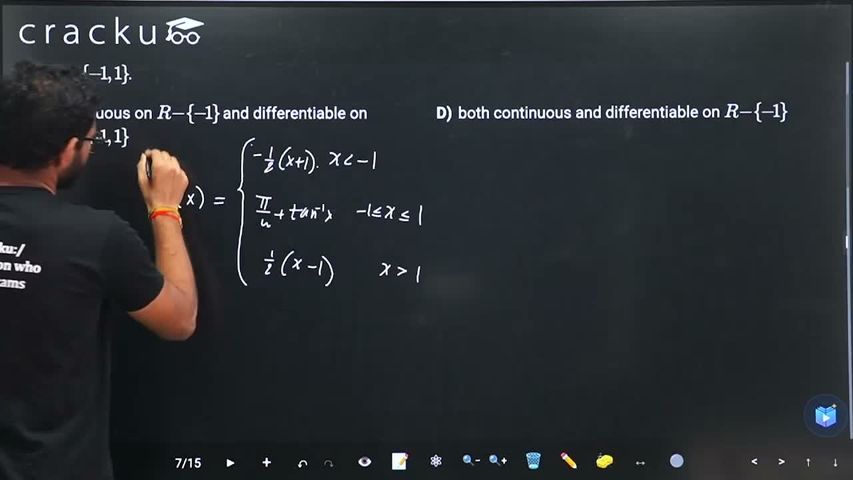
The function $$f(x) = \begin{cases} \frac{\pi}{4} + \tan^{-1}x, & |x| \leq 1 \\ \frac{1}{2}(|x| - 1), & |x| > 1 \end{cases}$$ is:
We have a function defined in two pieces,
$$ f(x)= \begin{cases} \dfrac{\pi}{4}+\tan^{-1}x, & |x|\le 1 \\[6pt] \dfrac12\,(|x|-1), & |x|>1 \end{cases} $$
Because the definition changes only at the points where the condition $$|x|=1$$ holds, that is, at $$x=-1$$ and $$x=1$$, any question about continuity or differentiability can arise only at these two points; elsewhere each individual formula is a standard elementary function and is automatically continuous and differentiable.
Continuity at $$x=1$$
The value of the function at $$x=1$$ comes from the first formula (since $$|1|\le1$$):
$$ f(1)=\frac{\pi}{4}+\tan^{-1}1 =\frac{\pi}{4}+\frac{\pi}{4} =\frac{\pi}{2}. $$
The right-hand limit, with $$x\to1^+$$, uses the second formula. For $$x>1$$ we have $$|x|=x$$, so
$$ \lim_{x\to1^+}f(x) =\lim_{x\to1^+}\frac12\,(x-1) =\frac12\,(1-1) =0. $$
The two numbers $$\dfrac{\pi}{2}$$ and $$0$$ are unequal, hence the right-hand limit is not equal to the value of the function. Therefore $$f$$ is not continuous at $$x=1$$.
Continuity at $$x=-1$$
Its value, now from the same first formula, is
$$ f(-1)=\frac{\pi}{4}+\tan^{-1}(-1) =\frac{\pi}{4}-\frac{\pi}{4} =0. $$
For $$x<-1$$ we have $$|x|=-x$$, so using the second formula the left-hand limit becomes
$$ \lim_{x\to-1^-}f(x) =\lim_{x\to-1^-}\frac12\,((-x)-1) =\frac12\,\bigl(-(-1)-1\bigr) =\frac12\,(1-1) =0. $$
The right-hand limit (from the first formula) is the same number, $$0$$, so both one-sided limits exist and equal the value of the function. Hence $$f$$ is continuous at $$x=-1$$.
Because the only discontinuity occurs at $$x=1$$, we conclude that
$$ f(x)\text{ is continuous on }\mathbb R-\{1\}. $$
Differentiability at $$x=-1$$
The derivative inside $$|x|\le1$$ is obtained from the standard rule $$\dfrac{d}{dx}\tan^{-1}x=\dfrac1{1+x^2}$$. Thus, for $$-1<x<1$$,
$$ f'(x)=\frac{1}{1+x^2}. $$
Taking the right-hand derivative at $$x=-1$$, we substitute $$x=-1$$:
$$ f'_+( -1)=\frac1{1+(-1)^2}=\frac12. $$
For $$x<-1$$ the expression $$f(x)=\dfrac12(-x-1)$$ can be differentiated directly, giving
$$ f'(x)=\frac12(-1)=-\frac12. $$
This is a constant, so the left-hand derivative at $$x=-1$$ is
$$ f'_-( -1)=-\frac12. $$
Since $$\dfrac12\neq-\dfrac12$$, the two one-sided derivatives disagree and $$f$$ is not differentiable at $$x=-1$$.
Differentiability at $$x=1$$
Differentiability always implies continuity, but we have already shown that $$f$$ is not even continuous at $$x=1$$. Therefore $$f$$ is certainly not differentiable at $$x=1$$.
Conclusion
We have shown:
• Continuous everywhere except at $$x=1$$.
• Differentiable everywhere except at $$x=-1$$ and $$x=1$$.
So the function is continuous on $$\mathbb R-\{1\}$$ and differentiable on $$\mathbb R-\{-1,1\}$$.
Hence, the correct answer is Option A.
Was this solution helpful?
Click on the Email ☝️ to Watch the Video Solution
Create a FREE account and get:
_1.webp)

Educational materials for JEE preparation

Ask our AI anything

AI can make mistakes. Please verify important information.
AI can make mistakes. Please verify important information.


