
Join Our JEE Preparation Group
Prep with like-minded aspirants; Get access to free daily tests and study material.
Sign in
Please select an account to continue using cracku.in
↓ →
Join Our JEE Preparation Group
Prep with like-minded aspirants; Get access to free daily tests and study material.
Step 1: Apply the AM GM Inequality
Since exponential functions always yield positive values, both $$2^{\sin x}$$ and $$2^{\cos x}$$ are strictly positive for all real values of $$x$$. This allows us to apply the Arithmetic Mean Geometric Mean inequality, which states that for any two positive numbers $$a$$ and $$b$$:
$$\frac{a + b}{2} \ge \sqrt{ab}$$
Substitute $$a = 2^{\sin x}$$ and $$b = 2^{\cos x}$$:
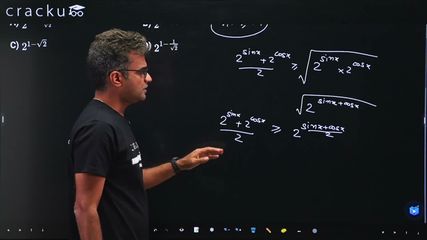
$$\frac{2^{\sin x} + 2^{\cos x}}{2} \ge \sqrt{2^{\sin x} \cdot 2^{\cos x}}$$
Step 2: Simplify the Right Hand Side
Use the exponent addition property $$a^m \cdot a^n = a^{m+n}$$ to combine the terms inside the square root:
$$\frac{2^{\sin x} + 2^{\cos x}}{2} \ge \sqrt{2^{\sin x + \cos x}}$$
Express the square root as a fractional exponent of $$\frac{1}{2}$$:
$$2^{\sin x} + 2^{\cos x} \ge 2 \cdot (2^{\sin x + \cos x})^{\frac{1}{2}}$$
$$2^{\sin x} + 2^{\cos x} \ge 2^1 \cdot 2^{\frac{\sin x + \cos x}{2}}$$
Combine the base 2 terms on the right side by adding their exponents:
$$2^{\sin x} + 2^{\cos x} \ge 2^{1 + \frac{\sin x + \cos x}{2}}$$
Step 3: Minimize the Exponent
For the entire expression to reach its absolute minimum, the exponent $$1 + \frac{\sin x + \cos x}{2}$$ must be minimized.
Recall the standard range for any trigonometric expression of the form $$a\sin x + b\cos x$$ is $$[-\sqrt{a^2+b^2}, \sqrt{a^2+b^2}]$$.
For our specific term $$\sin x + \cos x$$, the coefficients are $$a=1$$ and $$b=1$$.
Therefore, the minimum possible value of $$\sin x + \cos x$$ is $$-\sqrt{1^2 + 1^2} = -\sqrt{2}$$.
Substitute this minimum value back into the exponent's fraction:
$$\text{Minimum exponent} = 1 + \frac{-\sqrt{2}}{2}$$
Simplify the fraction by recognizing that $$2 = \sqrt{2} \cdot \sqrt{2}$$:
$$1 - \frac{\sqrt{2}}{2} = 1 - \frac{1}{\sqrt{2}}$$
Step 4: Final Evaluation
Substitute the fully minimized exponent back into our inequality from Step 2:
$$2^{\sin x} + 2^{\cos x} \ge 2^{1 - \frac{1}{\sqrt{2}}}$$
This proves that the absolute minimum value of the expression is exactly $$2^{1 - \frac{1}{\sqrt{2}}}$$.
Hence, the answer is option D.
Was this solution helpful?
Click on the Email ☝️ to Watch the Video Solution
Create a FREE account and get:
_1.webp)

Educational materials for JEE preparation

Ask our AI anything

AI can make mistakes. Please verify important information.
AI can make mistakes. Please verify important information.


