
Join Our JEE Preparation Group
Prep with like-minded aspirants; Get access to free daily tests and study material.
Sign in
Please select an account to continue using cracku.in
↓ →
Join Our JEE Preparation Group
Prep with like-minded aspirants; Get access to free daily tests and study material.
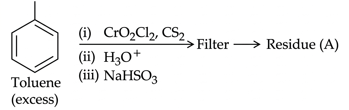
Residue (A) + HCl (dil)$$\rightarrow $$ Compound (B) Structure of residue (A) and Compound (B) formed respectively is :
During the alkaline hydrolysis (saponification) of ethyl acetoacetate, the ester group is converted into its sodium salt while ethanol is set free.
Reaction: $$CH_3COCH_2COOCH_2CH_3 + NaOH \rightarrow CH_3COCH_2COONa + C_2H_5OH$$
After the reaction mixture is boiled, the volatile ethanol distils off. On evaporating the remaining liquid to dryness, the solid that remains is the sodium salt of acetoacetic acid.
Hence $$\text{Residue (A)} = CH_3COCH_2COONa$$ (sodium acetoacetate)
When this residue is subsequently treated with dilute hydrochloric acid, simple proton exchange takes place to give the free β-keto-acid (acetoacetic acid) and sodium chloride.
$$CH_3COCH_2COONa + HCl_{(dil)} \rightarrow CH_3COCH_2COOH + NaCl$$
Therefore $$\text{Compound (B)} = CH_3COCH_2COOH$$ (acetoacetic acid)
Both structures together correspond to Option D.
Final answer: Option D which is: Residue (A) - sodium acetoacetate ($$CH_3COCH_2COONa$$) and Compound (B) - acetoacetic acid ($$CH_3COCH_2COOH$$).
Was this solution helpful?
Create a FREE account and get:
_1.webp)

Educational materials for JEE preparation

Ask our AI anything

AI can make mistakes. Please verify important information.
AI can make mistakes. Please verify important information.
