
Join Our JEE Preparation Group
Prep with like-minded aspirants; Get access to free daily tests and study material.
Sign in
Please select an account to continue using cracku.in
↓ →
Join Our JEE Preparation Group
Prep with like-minded aspirants; Get access to free daily tests and study material.
Let $$x_1, x_2, \ldots, x_{100}$$ be in an arithmetic progression, with $$x_1 = 2$$ and their mean equal to 200. If $$y_i = ix_i - i$$, $$1 \leq i \leq 100$$, then the mean of $$y_1, y_2, \ldots, y_{100}$$ is
Let the common difference of the arithmetic progression be
$$d.$$
Since the mean of the $$100$$ terms is
$$200,$$
we have
$$\frac{x_1+x_{100}}2=200.$$
Given
$$x_1=2,$$
therefore,
$$x_{100}=398.$$
Now,
$$x_{100}=2+99d,$$
so
$$2+99d=398$$
$$99d=396$$
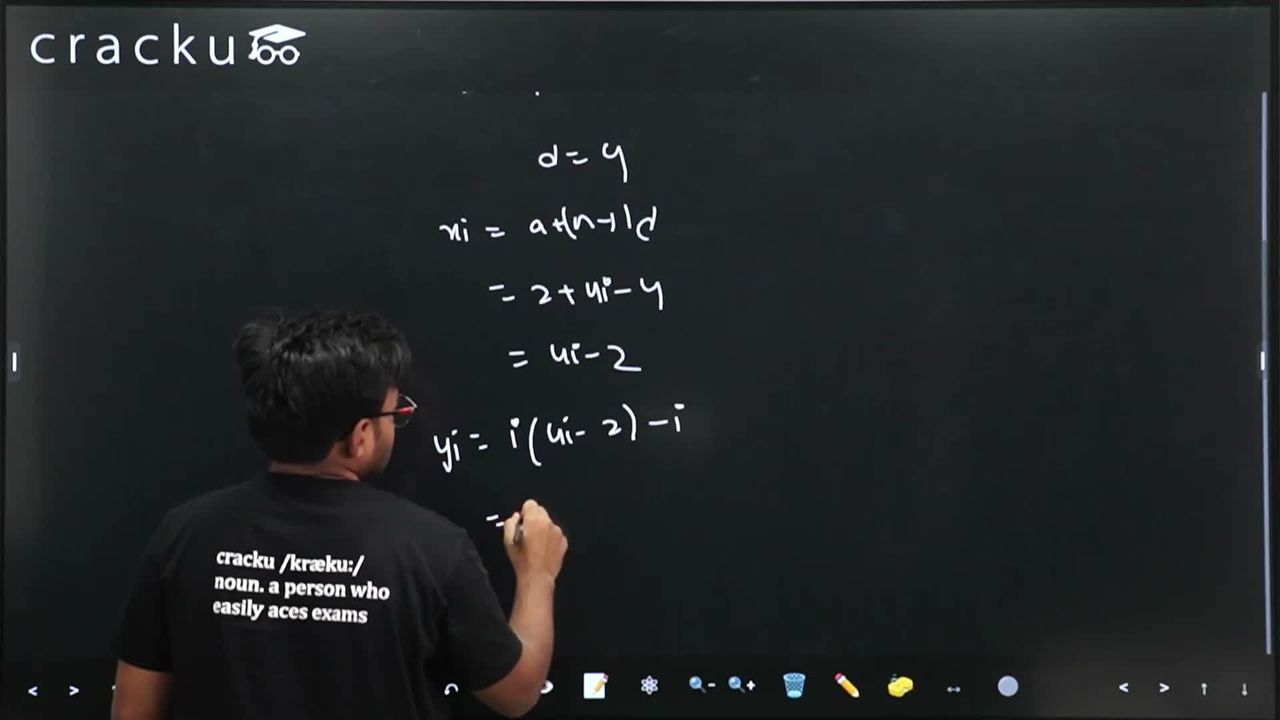
$$d=4.$$
Hence,
$$x_i=2+4(i-1)=4i-2.$$
Therefore,
$$y_i=i(4i-2)-i$$
$$=4i^2-3i.$$
The required mean is
$$\frac1{100}\sum_{i=1}^{100}(4i^2-3i).$$
Using
$$\sum_{i=1}^{100}i=\frac{100\cdot101}{2}=5050,$$
and
$$\sum_{i=1}^{100}i^2=\frac{100\cdot101\cdot201}{6}=338350,$$
we get
$$\sum_{i=1}^{100}(4i^2-3i)$$
$$=4(338350)-3(5050)$$
$$=1353400-15150$$
$$=1338250.$$
Hence, the required mean is
$$\frac{1338250}{100}$$
$$=\boxed{13382.5}.$$
Was this solution helpful?
Click on the Email ☝️ to Watch the Video Solution
Create a FREE account and get:
Educational materials for JEE preparation

Ask our AI anything

AI can make mistakes. Please verify important information.
AI can make mistakes. Please verify important information.

_1.webp)
