
Join Our JEE Preparation Group
Prep with like-minded aspirants; Get access to free daily tests and study material.
Sign in
Please select an account to continue using cracku.in
↓ →
Join Our JEE Preparation Group
Prep with like-minded aspirants; Get access to free daily tests and study material.
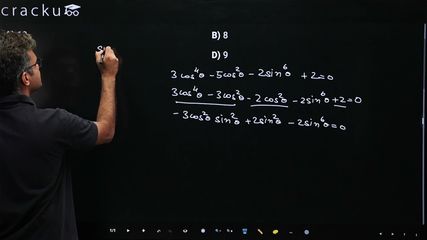
The number of elements in the set $$S = \{\theta \in [0, 2\pi]: 3\cos^4\theta - 5\cos^2\theta - 2\sin^6\theta + 2 = 0\}$$ is
Step 1: Transforming the Trigonometric Equation
The given equation is:
$$3\cos^4\theta - 5\cos^2\theta - 2\sin^6\theta + 2 = 0$$
To make the equation easier to factorize, let's convert everything into a single trigonometric ratio. Since we have both $$\cos$$ and $$\sin$$,
let's convert $$\sin^6\theta$$ in terms of $$\cos^2\theta$$ using the identity $$\sin^2\theta = 1 - \cos^2\theta$$:
$$2\sin^6\theta = 2(\sin^2\theta)^3 = 2(1 - \cos^2\theta)^3$$
Now let's use the substitution $$t = \cos^2\theta$$ to convert this into an algebraic polynomial. Note that since $$t = \cos^2\theta$$, the value of $$t$$ must lie in the range [0, 1]
Substituting $$t$$ into the equation gives:
$$3t^2 - 5t - 2(1 - t)^3 + 2 = 0$$
Step 2: Simplifying the Algebraic Polynomial
Expand the cubic term using the identity $$(1 - t)^3 = 1 - 3t + 3t^2 - t^3$$:
$$3t^2 - 5t - 2(1 - 3t + 3t^2 - t^3) + 2 = 0$$
$$3t^2 - 5t - 2 + 6t - 6t^2 + 2t^3 + 2 = 0$$
$$2t^3 + (3t^2 - 6t^2) + (-5t + 6t) + (-2 + 2) = 0$$
$$2t^3 - 3t^2 + t = 0$$
$$t(2t^2 - 3t + 1) = 0$$
$$2t^2 - 2t - t + 1 = 0$$
$$2t(t - 1) - 1(t - 1) = 0$$
$$(2t - 1)(t - 1) = 0$$
Thus, our completely factorized polynomial equation is:
$$t(2t - 1)(t - 1) = 0$$
This gives three possible roots for $$t$$:
Step 3: Finding the Number of Solutions for $$\theta \in [0, 2\pi]$$
Now substitute back $$t = \cos^2\theta$$:
Case 1: $$t = 0 \implies \cos^2\theta = 0 \implies \cos\theta = 0$$
In the interval $$[0, 2\pi]$$,
$$\theta = \frac{\pi}{2}, \frac{3\pi}{2}$$
Number of solutions = 2
Case 2: $$t = 1 \implies \cos^2\theta = 1 \implies \cos\theta = \pm 1$$
$$\theta = 0, \pi, 2\pi$$
Number of solutions = 3
Case 3: $$t = \frac{1}{2} \implies \cos^2\theta = \frac{1}{2} \implies \cos\theta = \pm \frac{1}{\sqrt{2}}$$
This gives solutions in all four quadrants:
$$\theta = \frac{\pi}{4}, \frac{3\pi}{4}, \frac{5\pi}{4}, \frac{7\pi}{4}$$
Number of solutions = 4
Step 4: Computing the Total Number of Elements in Set $$S$$
Total number of solutions = (Solutions from Case 1) + (Solutions from Case 2) + (Solutions from Case 3)
$$\text{Total Elements} = 2 + 3 + 4 = 9$$
Final Answer
The number of elements in the set $$S$$ is 9.
The correct option is D.
Was this solution helpful?
Click on the Email ☝️ to Watch the Video Solution
Create a FREE account and get:
_1.webp)

Educational materials for JEE preparation

Ask our AI anything

AI can make mistakes. Please verify important information.
AI can make mistakes. Please verify important information.
