
Join Our JEE Preparation Group
Prep with like-minded aspirants; Get access to free daily tests and study material.
Sign in
Please select an account to continue using cracku.in
↓ →
Join Our JEE Preparation Group
Prep with like-minded aspirants; Get access to free daily tests and study material.
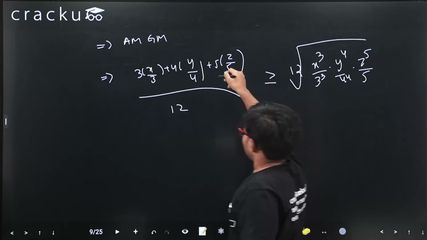
Let $$x$$, $$y$$, $$z$$ be positive real numbers such that $$x + y + z = 12$$ and $$x^3y^4z^5 = (0.1)(600)^3$$. Then $$x^3 + y^3 + z^3$$ is equal to
We have three positive real numbers $$x$$, $$y$$ and $$z$$ that satisfy the two conditions
$$x+y+z = 12 \qquad\text{and}\qquad x^{3}y^{4}z^{5}= (0.1)(600)^{3}.$$
First we evaluate the numerical constant on the right-hand side:
$$600^{3}=600\times600\times600=216\,000\,000,$$ $$0.1\times216\,000\,000 = 21\,600\,000.$$ So we must have
$$x^{3}y^{4}z^{5}=21\,600\,000.$$
To discover the values of $$x$$, $$y$$ and $$z$$ that make this possible while keeping the sum $$x+y+z$$ fixed, we maximise (or, since the value is fixed, simply solve for) the product subject to the given linear constraint. For such problems the standard tool is the method of Lagrange multipliers. We set
$$F(x,y,z,\lambda)=3\ln x+4\ln y+5\ln z-\lambda(x+y+z-12).$$
(We take logarithms because maximising $$x^{3}y^{4}z^{5}$$ is equivalent to maximising its natural logarithm.) Now we differentiate with respect to each variable and set the derivatives to zero:
$$\frac{\partial F}{\partial x}= \frac{3}{x}-\lambda =0 \;\Longrightarrow\; \lambda=\frac{3}{x},$$ $$\frac{\partial F}{\partial y}= \frac{4}{y}-\lambda =0 \;\Longrightarrow\; \lambda=\frac{4}{y},$$ $$\frac{\partial F}{\partial z}= \frac{5}{z}-\lambda =0 \;\Longrightarrow\; \lambda=\frac{5}{z}.$$
Because all three expressions equal the same $$\lambda$$, we equate them pairwise:
$$\frac{3}{x}=\frac{4}{y}=\frac{5}{z}.$$
From the first equality $$\dfrac{3}{x}=\dfrac{4}{y}$$ we obtain
$$4x = 3y \;\Longrightarrow\; \frac{x}{y} = \frac{3}{4}.$$
From the second equality $$\dfrac{4}{y}=\dfrac{5}{z}$$ we get
$$5y = 4z \;\Longrightarrow\; \frac{y}{z} = \frac{4}{5}.$$
Combining the two ratios, the numbers must be in the proportion
$$x : y : z = 3 : 4 : 5.$$
So we can write $$x = 3k,\; y = 4k,\; z = 5k$$ for some positive constant $$k$$. We substitute these into the linear condition $$x+y+z=12$$:
$$3k + 4k + 5k = 12 \;\Longrightarrow\; 12k = 12 \;\Longrightarrow\; k = 1.$$
Hence the unique triple that meets both requirements is
$$x = 3,\qquad y = 4,\qquad z = 5.$$
We now compute the required expression $$x^{3}+y^{3}+z^{3}$$:
$$x^{3}+y^{3}+z^{3}=3^{3}+4^{3}+5^{3}=27+64+125=216.$$
Hence, the correct answer is Option B.
Was this solution helpful?
Click on the Email ☝️ to Watch the Video Solution
Create a FREE account and get:
_1.webp)

Educational materials for JEE preparation

Ask our AI anything

AI can make mistakes. Please verify important information.
AI can make mistakes. Please verify important information.
