
Join Our JEE Preparation Group
Prep with like-minded aspirants; Get access to free daily tests and study material.
Sign in
Please select an account to continue using cracku.in
↓ →
Join Our JEE Preparation Group
Prep with like-minded aspirants; Get access to free daily tests and study material.
Shown below is the structure of methyl acetate with three different $$\alpha$$, $$\beta$$ and $$\gamma$$ carbon-oxygen bonds.
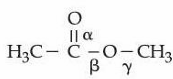
The correct order of bond lengths of these bonds is :
In methyl acetate ((CH_3COOCH_3)), the (\alpha) bond represents the carbonyl ((C=O)) bond, the (\beta) bond represents the (C-O) bond between the carbonyl carbon and the alkoxy oxygen, and the (\gamma) bond represents the (O-CH_3) bond.
The (\alpha) bond is a formal double bond with bond order approximately equal to (2). Therefore, it is the shortest carbon-oxygen bond in the molecule.
The (\beta) bond is formally a single bond, but due to resonance in the ester group,
$$CH_3-C(=O)-O-CH_3 \leftrightarrow CH_3-C(-O^-)=O^+-CH_3,$$
it acquires partial double bond character. Hence, its bond order lies between (1) and (2), making it shorter than a normal single bond but longer than a double bond.
The (\gamma) bond is a normal (C-O) single bond in the alkoxy group and does not participate significantly in resonance. Therefore, it has the lowest bond order and the greatest bond length.
Thus, the increasing order of bond lengths is
$$\alpha<\beta<\gamma.$$
Hence, the correct answer is (\alpha<\beta<\gamma).
Was this solution helpful?

Click on the Email ☝️ to Watch the Video Solution
Create a FREE account and get:
_1.webp)

Educational materials for JEE preparation

Ask our AI anything

AI can make mistakes. Please verify important information.
AI can make mistakes. Please verify important information.
