
Join Our JEE Preparation Group
Prep with like-minded aspirants; Get access to free daily tests and study material.
Sign in
Please select an account to continue using cracku.in
↓ →
Join Our JEE Preparation Group
Prep with like-minded aspirants; Get access to free daily tests and study material.
Let $$x^k + y^k = a^k$$, $$(a, k > 0)$$ and $$\frac{dy}{dx} + \left(\frac{y}{x}\right)^{\frac{1}{3}} = 0$$, then $$k$$ is
We are given two relations that hold simultaneously for the same variables $$x$$ and $$y$$.
First, we have the algebraic relation
$$x^{k}+y^{k}=a^{k},\qquad a>0,\;k>0.$$
Secondly, the variables satisfy the differential equation
$$\frac{dy}{dx}+\left(\frac{y}{x}\right)^{\frac13}=0.$$
Our aim is to determine the value of $$k$$ that allows both relations to be true together.
We start by differentiating the relation $$x^{k}+y^{k}=a^{k}$$ with respect to $$x$$. Since $$a^{k}$$ is a constant, its derivative is zero. Remembering that the derivative of $$x^{k}$$ with respect to $$x$$ is $$k\,x^{k-1}$$ and applying the chain rule to $$y^{k}$$, we obtain
$$\frac{d}{dx}\bigl(x^{k}\bigr)+\frac{d}{dx}\bigl(y^{k}\bigr)=0,$$
so
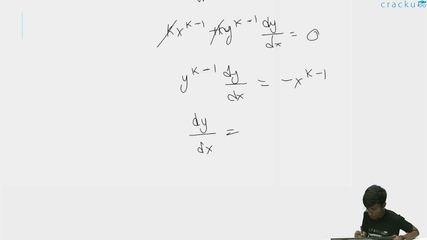
$$k\,x^{\,k-1}+k\,y^{\,k-1}\,\frac{dy}{dx}=0.$$
Dividing every term by the common factor $$k$$ gives
$$x^{\,k-1}+y^{\,k-1}\,\frac{dy}{dx}=0.$$
Now we isolate $$\dfrac{dy}{dx}$$:
$$y^{\,k-1}\,\frac{dy}{dx}=-x^{\,k-1},$$
and hence
$$\frac{dy}{dx}=-\frac{x^{\,k-1}}{y^{\,k-1}}.$$
But the differential equation supplied in the question already tells us that
$$\frac{dy}{dx}=-\left(\frac{y}{x}\right)^{\frac13}.$$
Because both expressions represent the same $$\dfrac{dy}{dx}$$, we can equate them (the negative signs cancel immediately):
$$\frac{x^{\,k-1}}{y^{\,k-1}}=\left(\frac{y}{x}\right)^{\frac13}.$$
We now rewrite the right-hand side by distributing the exponent $$\dfrac13$$ to the numerator and the denominator:
$$\left(\frac{y}{x}\right)^{\frac13}=y^{\frac13}\,x^{-\frac13}.$$
So the equality becomes
$$x^{\,k-1}\,y^{-(k-1)}=x^{-\frac13}\,y^{\frac13}.$$
We now compare the exponents of $$x$$ and the exponents of $$y$$ separately. For the powers of $$x$$ we have
$$k-1=-\frac13,$$
which directly gives
$$k=1-\frac13=\frac23.$$
For completeness we check the powers of $$y$$. On the left the exponent is $$-(k-1)=1-k$$, and on the right it is $$\dfrac13$$. Substituting $$k=\dfrac23$$ indeed gives
$$1-\frac23=\frac13,$$
so the equality is fully consistent.
Since the exponents match perfectly only for $$k=\dfrac23$$, that value is the unique solution.
Hence, the correct answer is Option C.
Was this solution helpful?
Click on the Email ☝️ to Watch the Video Solution
Create a FREE account and get:
_1.webp)

Educational materials for JEE preparation

Ask our AI anything

AI can make mistakes. Please verify important information.
AI can make mistakes. Please verify important information.


