
Join Our JEE Preparation Group
Prep with like-minded aspirants; Get access to free daily tests and study material.
Sign in
Please select an account to continue using cracku.in
↓ →
Join Our JEE Preparation Group
Prep with like-minded aspirants; Get access to free daily tests and study material.
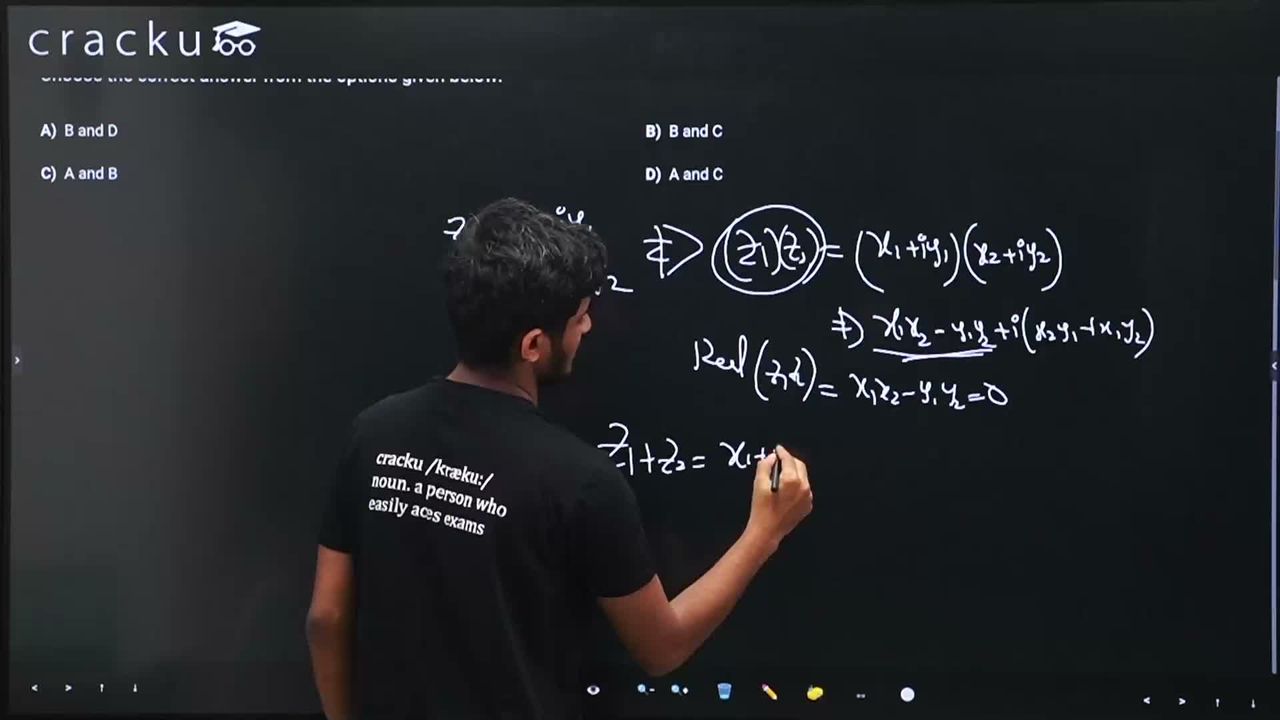
For two non-zero complex numbers $$z_1$$ and $$z_2$$, if $$\text{Re}(z_1 z_2) = 0$$ and $$\text{Re}(z_1 + z_2) = 0$$, then which of the following are possible?
(A) Im $$(z_1) > 0$$ and Im $$(z_2) > 0$$
(B) Im $$(z_1) < 0$$ and Im $$(z_2) > 0$$
(C) Im $$(z_1) > 0$$ and Im $$(z_2) < 0$$
(D) Im $$(z_1) < 0$$ and Im $$(z_2) < 0$$
Choose the correct answer from the options given below:
For two non-zero complex numbers $$z_1$$ and $$z_2$$, let them be defined as:
$$z_1 = x_1 + i y_1$$
$$z_2 = x_2 + i y_2$$
Since $$z_1$$ and $$z_2$$ are non-zero, their real and imaginary parts cannot be zero at the same time.
Step 1: Apply the first condition
$$\text{Re}(z_1 + z_2) = 0$$
$$x_1 + x_2 = 0$$
$$x_2 = -x_1$$
Step 2: Apply the second condition
$$\text{Re}(z_1 z_2) = 0$$
$$\text{Re}((x_1 + i y_1)(x_2 + i y_2)) = 0$$
$$x_1 x_2 - y_1 y_2 = 0$$
Step 3: Substitute $$x_2 = -x_1$$ into the product equation
$$x_1(-x_1) - y_1 y_2 = 0$$
$$-x_1^2 - y_1 y_2 = 0$$
$$y_1 y_2 = -x_1^2$$
Step 4: Analyze the signs
If $$x_1 = 0$$, then $$x_2 = 0$$. This forces $$y_1 y_2 = 0$$.
If $$y_1 = 0$$, then $$z_1 = 0$$, which violates the non-zero condition.
Therefore, $$x_1 \neq 0$$, which means $$x_1^2 > 0$$.
Consequently, $$y_1 y_2 = -x_1^2 < 0$$.
Since the product of their imaginary parts is strictly negative ($$y_1 y_2 < 0$$), the imaginary parts must have opposite signs.
Possible Cases:
Case 1: $$\text{Im}(z_1) < 0$$ and $$\text{Im}(z_2) > 0$$ (Statement B)
Case 2: $$\text{Im}(z_1) > 0$$ and $$\text{Im}(z_2) < 0$$ (Statement C)
Correct answer is (B) and (C).
Was this solution helpful?
Click on the Email ☝️ to Watch the Video Solution
Create a FREE account and get:
_1.webp)

Educational materials for JEE preparation

Ask our AI anything

AI can make mistakes. Please verify important information.
AI can make mistakes. Please verify important information.
