
Join Our JEE Preparation Group
Prep with like-minded aspirants; Get access to free daily tests and study material.
Sign in
Please select an account to continue using cracku.in
↓ →
Join Our JEE Preparation Group
Prep with like-minded aspirants; Get access to free daily tests and study material.
Let $$\lambda \neq 0$$ be a real number. Let $$\alpha, \beta$$ be the roots of the equation $$14x^2 - 31x + 3\lambda = 0$$ and $$\alpha, \gamma$$ be the roots of the equation $$35x^2 - 53x + 4\lambda = 0$$. Then $$\frac{3\alpha}{\beta}$$ and $$\frac{4\alpha}{\gamma}$$ are the roots of the equation:
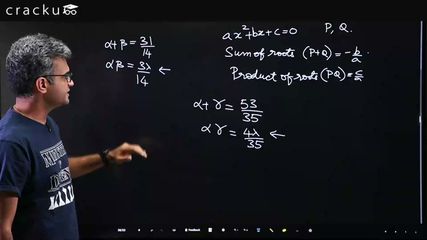
Let $$\alpha,\beta$$ be roots of $$14x^2 - 31x + 3\lambda = 0$$ and $$\alpha,\gamma$$ be roots of $$35x^2 - 53x + 4\lambda = 0\!.$$ By Vieta’s formulas, from the first equation we have $$\alpha + \beta = \frac{31}{14}$$ and $$\alpha\beta = \frac{3\lambda}{14}$$, while from the second equation $$\alpha + \gamma = \frac{53}{35}$$ and $$\alpha\gamma = \frac{4\lambda}{35}\!.$$ Since $$\alpha$$ is a common root, it satisfies
$$14\alpha^2 - 31\alpha + 3\lambda = 0 \quad \cdots (1)$$ $$35\alpha^2 - 53\alpha + 4\lambda = 0 \quad \cdots (2)$$
From (1) we get $$\lambda = \frac{31\alpha - 14\alpha^2}{3}$$ and substituting this into (2) yields
$$35\alpha^2 - 53\alpha + 4\cdot\frac{31\alpha - 14\alpha^2}{3} = 0$$ $$105\alpha^2 - 159\alpha + 124\alpha - 56\alpha^2 = 0$$ $$49\alpha^2 - 35\alpha = 0$$ $$7\alpha(7\alpha - 5) = 0\!.$$
Since $$\lambda \neq 0$$ we have $$\alpha \neq 0$$, hence $$\alpha = \frac{5}{7}\!.$$ Then
$$\beta = \frac{31}{14} - \frac{5}{7} = \frac{31}{14} - \frac{10}{14} = \frac{21}{14} = \frac{3}{2},$$ $$\gamma = \frac{53}{35} - \frac{5}{7} = \frac{53}{35} - \frac{25}{35} = \frac{28}{35} = \frac{4}{5},$$ $$\lambda = \frac{14 \times \frac{5}{7} \times \frac{3}{2}}{3} = \frac{14 \times \frac{15}{14}}{3} = \frac{15}{3} = 5\!.$$
Next, we calculate
$$\frac{3\alpha}{\beta} = \frac{3 \times \frac{5}{7}}{\frac{3}{2}} = \frac{\frac{15}{7}}{\frac{3}{2}} = \frac{15}{7} \times \frac{2}{3} = \frac{10}{7},$$ $$\frac{4\alpha}{\gamma} = \frac{4 \times \frac{5}{7}}{\frac{4}{5}} = \frac{\frac{20}{7}}{\frac{4}{5}} = \frac{20}{7} \times \frac{5}{4} = \frac{25}{7}\!.$$
Hence the sum and product of these quantities are
$$\frac{10}{7} + \frac{25}{7} = 5,\qquad \frac{10}{7} \times \frac{25}{7} = \frac{250}{49}\!.$$
Therefore, the required equation with these sum and product is
$$x^2 - 5x + \frac{250}{49} = 0,$$ or equivalently, multiplying through by 49,
$$49x^2 - 245x + 250 = 0\!.$$
This matches Option 3. The answer is $$49x^2 - 245x + 250 = 0$$.
Was this solution helpful?
Click on the Email ☝️ to Watch the Video Solution
Create a FREE account and get:
_1.webp)

Educational materials for JEE preparation

Ask our AI anything

AI can make mistakes. Please verify important information.
AI can make mistakes. Please verify important information.
