
Join Our JEE Preparation Group
Prep with like-minded aspirants; Get access to free daily tests and study material.
Sign in
Please select an account to continue using cracku.in
↓ →
Join Our JEE Preparation Group
Prep with like-minded aspirants; Get access to free daily tests and study material.
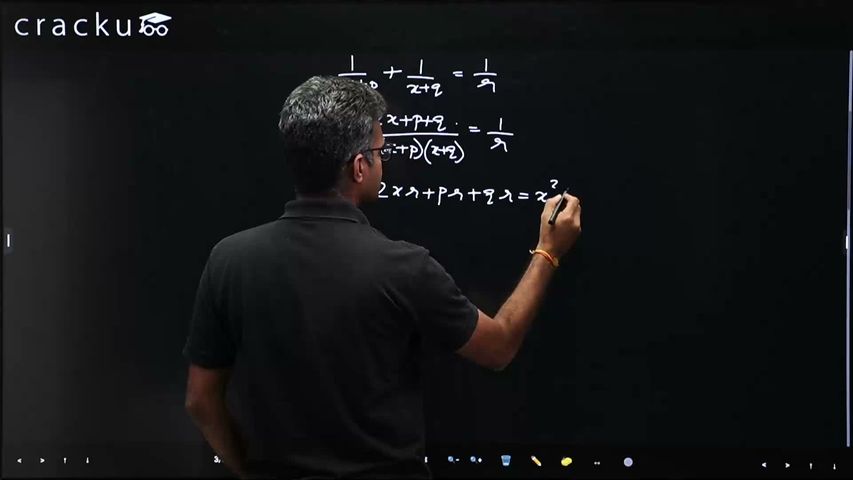
Let p, q and r be real numbers ($$p \neq q, r \neq 0$$), such that the roots of the equation $$\frac{1}{x+p} + \frac{1}{x+q} = \frac{1}{r}$$ are equal in magnitude but opposite in sign, then the sum of squares of these roots is equal to:
We start from the given equation
$$\frac{1}{x+p}+\frac{1}{x+q}=\frac{1}{r},\qquad p\neq q,\; r\neq 0.$$
To remove the denominators we first take the L.C.M. of the two fractions on the left. The L.C.M. is $$(x+p)(x+q),$$ so we write
$$\frac{(x+q)+(x+p)}{(x+p)(x+q)}=\frac{1}{r}.$$
The numerator simplifies because $$(x+q)+(x+p)=2x+p+q$$. Hence we have
$$\frac{2x+p+q}{(x+p)(x+q)}=\frac{1}{r}.$$
Now we cross-multiply:
$$r\,(2x+p+q)=(x+p)(x+q).$$
Next we expand the right-hand side. Using the identity $$(x+p)(x+q)=x^{2}+x(p+q)+pq,$$ we obtain
$$r(2x+p+q)=x^{2}+x(p+q)+pq.$$
We bring every term to the right so that the quadratic is arranged in standard form $$x^{2}+Bx+C=0$$:
$$x^{2}+x(p+q)-r(2x)-r(p+q)+pq=0.$$
Gathering the coefficients of $$x$$ and the constant terms we write
$$x^{2}+\big[(p+q)-2r\big]\,x+\big[pq-r(p+q)\big]=0.$$
This is a quadratic equation of the form
$$x^{2}+Bx+C=0$$
with $$B=(p+q)-2r\quad\text{and}\quad C=pq-r(p+q).$$
The problem states that its two roots are equal in magnitude but opposite in sign. Let us denote the roots by $$a\quad\text{and}\quad -a.$$
For a quadratic $$x^{2}+Bx+C=0$$, Vieta’s formulas tell us
Sum of roots $$= -B,\qquad$$ Product of roots $$= C.$$
Because our roots are $$a$$ and $$-a$$, their sum is
$$a+(-a)=0.$$
So, employing the sum-of-roots formula, we set
$$-B=0\;\Longrightarrow\;B=0.$$
Substituting the value of $$B$$ that we calculated earlier gives
$$(p+q)-2r=0.$$
Solving this simple linear equation for $$r$$ yields
$$2r=p+q\;\Longrightarrow\; r=\frac{p+q}{2}.$$
We now use the product-of-roots formula. The product of the roots satisfies
$$a\cdot(-a)=-a^{2}=C=pq-r(p+q).$$
Rewriting we find
$$a^{2}=-(pq-r(p+q))=-pq+r(p+q).$$
We already know that $$r=\dfrac{p+q}{2},$$ so we substitute this value of $$r$$:
$$a^{2}=-pq+\frac{p+q}{2}\,(p+q)= -pq+\frac{(p+q)^{2}}{2}.$$
The expression $$(p+q)^{2}$$ expands to $$p^{2}+2pq+q^{2}.$$ Hence
$$a^{2}=-pq+\frac{p^{2}+2pq+q^{2}}{2}.$$
We place both terms over a common denominator $$2$$:
$$a^{2}=\frac{-2pq+p^{2}+2pq+q^{2}}{2}=\frac{p^{2}+q^{2}}{2}.$$
The question asks for the sum of squares of the two roots. Since the roots are $$a$$ and $$-a$$, their squares are $$a^{2}$$ and $$(-a)^{2}=a^{2}$$ again. Therefore
$$\text{Sum of squares}=a^{2}+a^{2}=2a^{2}.$$
Substituting the value we have just found for $$a^{2}$$ gives
$$2a^{2}=2\left(\frac{p^{2}+q^{2}}{2}\right)=p^{2}+q^{2}.$$
We have arrived exactly at the expression in Option A.
Hence, the correct answer is Option A.
Was this solution helpful?
Click on the Email ☝️ to Watch the Video Solution
Create a FREE account and get:
_1.webp)

Educational materials for JEE preparation

Ask our AI anything

AI can make mistakes. Please verify important information.
AI can make mistakes. Please verify important information.
