
Join Our JEE Preparation Group
Prep with like-minded aspirants; Get access to free daily tests and study material.
Sign in
Please select an account to continue using cracku.in
↓ →
Join Our JEE Preparation Group
Prep with like-minded aspirants; Get access to free daily tests and study material.
In the given reaction
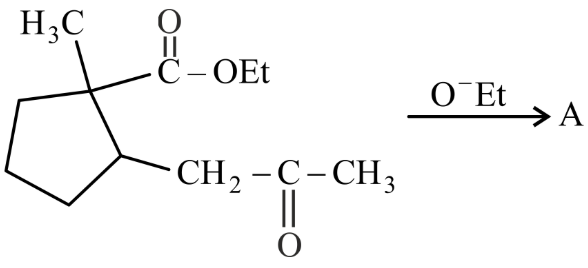
(Where Et is $$-C_2H_5$$)
The number of chiral carbon(s) in product A is ______.
Correct Answer: 2
The molecule contains both a ketone and an ester group.
In presence of ethoxide $$\mathrm{(-OEt)}$$, the reaction proceeds through an intramolecular Claisen condensation.
The base removes the most accessible acidic $$\mathrm{\alpha}$$-hydrogen from the terminal methyl group $$\mathrm{(-CH_3)}$$ adjacent to the ketone.
This pathway is favoured because it forms a stable six-membered ring instead of a strained four-membered ring.
The resulting enolate attacks the ester carbonyl carbon, followed by elimination of the ethoxy group.
This produces a fused bicyclic $$\mathrm{\beta}$$-diketone system.
The only chiral carbons present are the two bridgehead carbons where the rings are fused.
All remaining carbons are either:
$$\mathrm{sp^2}$$
hybridised carbonyl carbons or methylene carbons containing identical hydrogens.
Hence, the number of chiral carbons in product $$\mathrm{A}$$ is:
$$\mathrm{2}$$
Correct Answer: $$\mathrm{2}$$
Was this solution helpful?
Click on the Email ☝️ to Watch the Video Solution
Create a FREE account and get:
_1.webp)

Educational materials for JEE preparation

Ask our AI anything

AI can make mistakes. Please verify important information.
AI can make mistakes. Please verify important information.
