
Join Our JEE Preparation Group
Prep with like-minded aspirants; Get access to free daily tests and study material.
Sign in
Please select an account to continue using cracku.in
↓ →
Join Our JEE Preparation Group
Prep with like-minded aspirants; Get access to free daily tests and study material.
Match List-I (Separation of) with List-II (Separation Technique) :
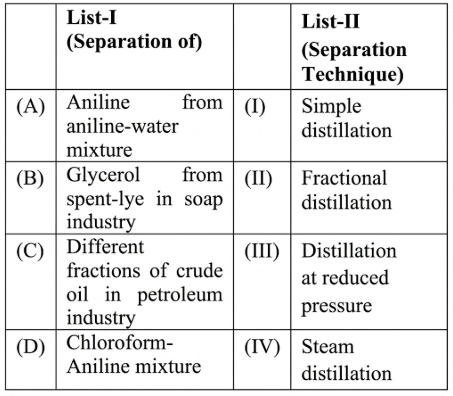
Choose the correct answer from the options given below :
In separation techniques we always match the physical property of the mixture with the most suitable method:
Case A: Aniline-water mixture
Aniline boils around $$184^{\circ}\text{C}$$ and is immiscible with water. When such a liquid is subjected to steam, the total vapour pressure is the sum of the individual vapour pressures, so the mixture boils below $$100^{\circ}\text{C}$$ and aniline distils along with steam. Hence the correct technique is steam distillation.
Case B: Glycerol from spent-lye in the soap industry
Pure glycerol decomposes near its normal boiling point $$\left(\approx 290^{\circ}\text{C}\right)$$. To avoid decomposition it is distilled under low pressure, so that it boils at a much lower temperature. Therefore we need distillation at reduced (vacuum) pressure.
Case C: Different fractions of crude oil
Crude petroleum contains components whose boiling ranges overlap over fairly narrow intervals. Separation is done in a fractionating column where rising vapours repeatedly condense and revapourise. This is classical fractional distillation.
Case D: Chloroform-aniline mixture
Chloroform boils at $$61^{\circ}\text{C}$$ while aniline boils at $$184^{\circ}\text{C}$$. Such a large difference means the lower-boiling component can be collected first without elaborate apparatus. Hence we use simple distillation.
Summarising the matches:
(A) Aniline / water → IV Steam distillation
(B) Glycerol / spent-lye → III Distillation at reduced pressure
(C) Crude-oil fractions → II Fractional distillation
(D) Chloroform / aniline → I Simple distillation
Therefore the correct choice is Option A.
Was this solution helpful?
Click on the Email ☝️ to Watch the Video Solution
Create a FREE account and get:
_1.webp)

Educational materials for JEE preparation

Ask our AI anything

AI can make mistakes. Please verify important information.
AI can make mistakes. Please verify important information.
