Join Our JEE Preparation Group
Prep with like-minded aspirants; Get access to free daily tests and study material.
Sign in
Please select an account to continue using cracku.in
↓ →
Join Our JEE Preparation Group
Prep with like-minded aspirants; Get access to free daily tests and study material.
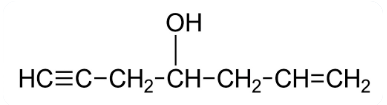
The given structure is $$HC \equiv C - CH_2 - CH(OH) - CH_2 - CH = CH_2$$.
Step 1: Select the parent chain
The longest continuous chain that contains the hydroxyl group as well as both the double and the triple bonds has seven carbon atoms, so the parent hydrocarbon is $$hept$$.
Step 2: Decide the principal characteristic group
According to IUPAC priority order, the $${-}OH$$ group (alcohol) has higher suffix priority than double or triple bonds. Hence the compound will be named with the suffix $$-ol$$, not with the prefix “hydroxy”.
Step 3: Number the chain
We need the lowest possible set of locants for the principal group, the multiple bonds, and any substituents.
Case A (left → right):
C-1≡C-2-C-3-C-4(OH)-C-5-C-6= C-7
Locants: 1-yne, 4-ol, 6-ene ⇒ set $$(1,4,6)$$.
Case B: (right → left):
C-1= C-2-C-3-C-4(OH)-C-5-C-6≡C-7
Locants: 1-ene, 4-ol, 6-yne ⇒ set $$(1,4,6)$$.
Both directions give the same numerical set $$(1,4,6)$$. When a tie exists, IUPAC rules state that the lower locant is assigned to the double bond (-ene) rather than to the triple bond (-yne). Therefore Case B is preferred, keeping the double bond at $$C_1$$.
Step 4: Write the complete name
• Parent chain: $$hept$$ (7 carbons)
• Double bond between C-1 and C-2 ⇒ $$1-en$$
• Triple bond between C-6 and C-7 ⇒ $$6-yn$$
• Hydroxyl group on C-4 ⇒ $$4-ol$$ (suffix of highest priority)
Combining these parts in the correct order (ene, yne, ol):
$$\text{Hept-1-en-6-yn-4-ol}$$
Step 5: Match with the options
Option D states “Hept-1-en-6-yn-4-ol”, which is exactly the name obtained.
Hence, the correct answer is Option D (Hept-1-en-6-yn-4-ol).
Was this solution helpful?
Click on the Email ☝️ to Watch the Video Solution
Create a FREE account and get:
_1.webp)

Educational materials for JEE preparation

Ask our AI anything

AI can make mistakes. Please verify important information.
AI can make mistakes. Please verify important information.