
Join Our JEE Preparation Group
Prep with like-minded aspirants; Get access to free daily tests and study material.
Sign in
Please select an account to continue using cracku.in
↓ →
Join Our JEE Preparation Group
Prep with like-minded aspirants; Get access to free daily tests and study material.
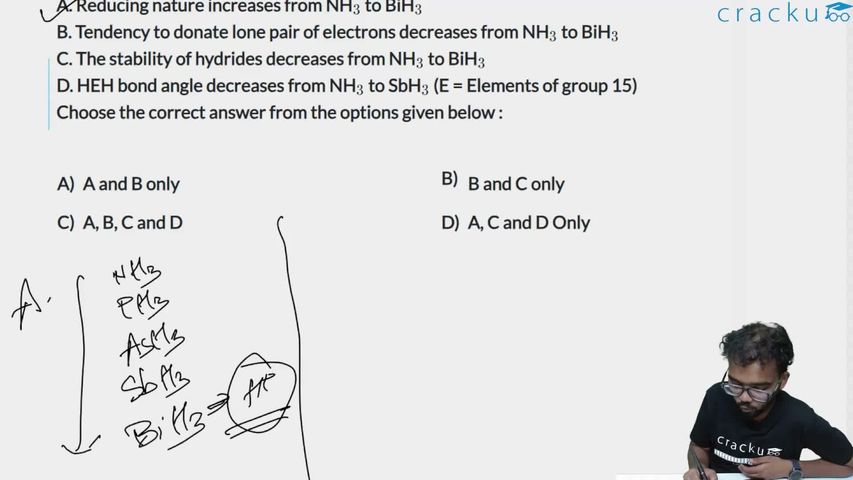
Find the correct statements related to group 15 hydrides.
A. Reducing nature increases from NH$$_3$$ to BiH$$_3$$
B. Tendency to donate lone pair of electrons decreases from NH$$_3$$ to BiH$$_3$$
C. The stability of hydrides decreases from NH$$_3$$ to BiH$$_3$$
D. HEH bond angle decreases from NH$$_3$$ to SbH$$_3$$ (E = Elements of group 15)
Choose the correct answer from the options given below :
The reducing nature of Group 15 hydrides increases from (NH_3) to (BiH_3) because the (E-H) bond strength decreases down the group due to increasing atomic size and poorer orbital overlap. Hence, the hydrides release hydrogen more readily.
Therefore,
$$\boxed{\text{Statement A is correct}.}$$
The tendency to donate the lone pair of electrons decreases from (NH_3) to (BiH_3). As the size of the central atom increases, the lone pair occupies a larger orbital and becomes less available for donation, resulting in decreased basicity.
Therefore,
$$\boxed{\text{Statement B is correct}.}$$
The stability of the hydrides decreases down the group because the (E-H) bond becomes progressively weaker with increasing atomic size.
Therefore,
$$\boxed{\text{Statement C is correct}.}$$
The (H-E-H) bond angle decreases from (NH_3) to (SbH_3). While (NH_3) has a bond angle of about (107^\circ), the heavier hydrides show reduced hybridization and the bond angles approach (90^\circ).
Therefore,
$$\boxed{\text{Statement D is correct}.}$$
Hence, all four statements are correct.
$$\boxed{\text{Correct Answer: A, B, C and D}.}$$
Was this solution helpful?
Click on the Email ☝️ to Watch the Video Solution
Create a FREE account and get:
_1.webp)

Educational materials for JEE preparation

Ask our AI anything

AI can make mistakes. Please verify important information.
AI can make mistakes. Please verify important information.
