Join Our JEE Preparation Group
Prep with like-minded aspirants; Get access to free daily tests and study material.
Sign in
Please select an account to continue using cracku.in
↓ →
Join Our JEE Preparation Group
Prep with like-minded aspirants; Get access to free daily tests and study material.
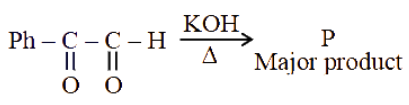
The starting material is phenylglyoxal, $$\text{Ph-C(=O)-CHO},$$ which is an $\alpha$-ketoaldehyde. It contains two carbonyl groups but does not possess any $\alpha$-hydrogen atoms.
The reaction is carried out in the presence of $$KOH$$ and heat $$\Delta.$$
When an aldehyde lacking $\alpha$-hydrogens is treated with a strong base, it undergoes the Cannizzaro reaction. Since phenylglyoxal contains both an aldehyde and a ketone group within the same molecule, it undergoes an intramolecular Cannizzaro reaction.
In a Cannizzaro reaction, one carbonyl group is oxidized while the other is reduced. Here, the aldehyde portion is oxidized to a carboxylate ion, whereas the ketone portion is reduced to an alcohol.
The mechanism proceeds as follows:
Thus,
The final product obtained is potassium mandelate, having the structure
$$\boxed{\text{Ph-CH(OH)-COO}^-,\text{K}^+.}$$
Therefore, the correct answer is
$$\boxed{\text{Option (B).}}$$
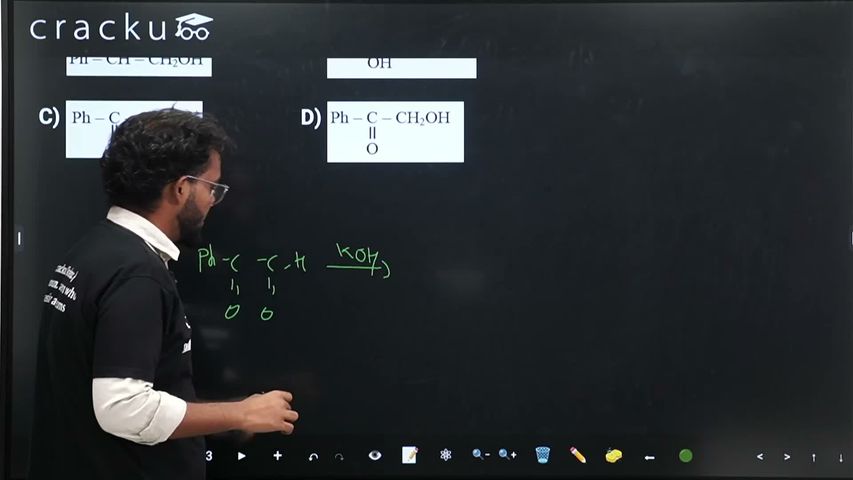
Click on the Email ☝️ to Watch the Video Solution
Create a FREE account and get:
_1.webp)

Educational materials for JEE preparation

Ask our AI anything

AI can make mistakes. Please verify important information.
AI can make mistakes. Please verify important information.