
Join Our JEE Preparation Group
Prep with like-minded aspirants; Get access to free daily tests and study material.
Sign in
Please select an account to continue using cracku.in
↓ →
Join Our JEE Preparation Group
Prep with like-minded aspirants; Get access to free daily tests and study material.
Compounds that should not be used as primary standards in titrimetric analysis are:
A. $$Na_2Cr_2O_7$$
B. Oxalic acid
C. NaOH
D. $$FeSO_4 \cdot 6H_2O$$
E. Sodium tetraborate
Choose the most appropriate answer from the options given below:
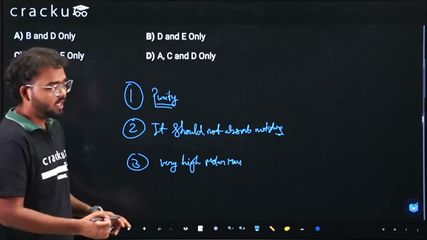
In titrimetric (volumetric) analysis a primary standard is the substance that is weighed accurately, dissolved, and its solution is used to standardise another reagent. For a compound to serve as a primary standard it must satisfy all the conditions below:
• Very high purity and known formula
• Stable in air (non-hygroscopic, non-deliquescent, does not react with $$CO_2$$ or $$O_2$$)
• Reasonably high molar/equivalent mass (reduces weighing error)
• Soluble in the chosen solvent and gives a stoichiometric reaction
• Non-toxic and easily available
Let us test each compound given in the question against the above requirements.
Case A:
$$Na_2Cr_2O_7$$ (sodium dichromate)
This salt is strongly hygroscopic and absorbs moisture from air, so its weighed mass does not give a fixed number of moles. Hence it fails the “stable in air” criterion and should not be used as a primary standard.
Case B:
Oxalic acid, generally used as the dihydrate $$H_2C_2O_4\cdot 2H_2O$$, is available in high purity, has a fixed water of crystallisation, is not hygroscopic, and has a suitable equivalent mass. Therefore it is a good primary standard and is widely used for standardising $$KMnO_4$$.
Case C:
NaOH (sodium hydroxide) readily absorbs both $$H_2O$$ (moisture) and $$CO_2$$ from the atmosphere, forming $$Na_2CO_3$$. Because of this, its composition changes while weighing. Thus NaOH cannot be used as a primary standard.
Case D:
$$FeSO_4\cdot 6H_2O$$ (ferrous sulphate hexahydrate) slowly oxidises to $$Fe^{3+}$$ in air and also effloresces (loses water). Hence its exact formula weight changes with time. It is therefore unsuitable as a primary standard.
Case E:
Sodium tetraborate (borax), $$Na_2B_4O_7\cdot 10H_2O$$, is available in very pure form, is not appreciably hygroscopic, and has a high equivalent mass. Because it meets all the criteria, it is an excellent primary standard for acid-base titrations.
Summarising the suitability:
• Not suitable → A ($$Na_2Cr_2O_7$$), C (NaOH), D ($$FeSO_4\cdot 6H_2O$$)
• Suitable → B (oxalic acid), E (sodium tetraborate)
The compounds that should NOT be used as primary standards are therefore A, C and D only.
Option D is correct.
Was this solution helpful?
Click on the Email ☝️ to Watch the Video Solution
Create a FREE account and get:
_1.webp)

Educational materials for JEE preparation

Ask our AI anything

AI can make mistakes. Please verify important information.
AI can make mistakes. Please verify important information.
