
Join Our JEE Preparation Group
Prep with like-minded aspirants; Get access to free daily tests and study material.
Sign in
Please select an account to continue using cracku.in
↓ →
Join Our JEE Preparation Group
Prep with like-minded aspirants; Get access to free daily tests and study material.
A student has studied the decomposition of a gas $$AB_3$$ at 25°C. He obtained the following data
| p (mm Hg) | 50 | 100 | 200 | 400 |
|---|---|---|---|---|
| Relative $$t_{1/2}$$ (s) | 4 | 2 | 1 | 0.5 |
The order of the reaction is
For an $$n^{th}$$ order reaction, the half-life is related to the initial concentration or pressure by
$$t_{1/2}\propto \frac{1}{p^{,n-1}}$$
or equivalently,
$$t_{1/2}\propto p^{,1-n}$$
Using two data points from the table,
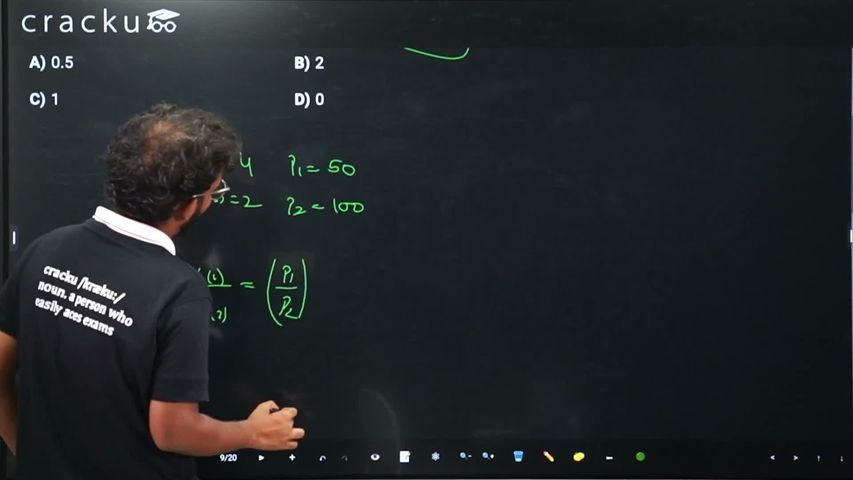
$$p_1=50,\quad (t_{1/2})_1=4$$
$$p_2=100,\quad (t_{1/2})_2=2$$
Taking the ratio,
$$\frac{(t_{1/2})1}{(t1/2)_2}=\left(\frac{p_1}{p_2}\right)^{1-n}$$
Substituting the values,
$$\frac{4}{2}=\left(\frac{50}{100}\right)^{1-n}$$
$$2=\left(\frac{1}{2}\right)^{1-n}$$
Using $$\frac{1}{2}=2^{-1}$$,
$$2^1=(2^{-1})^{1-n}$$
$$2^1=2^{-(1-n)}$$
$$2^1=2^{n-1}$$
Equating the exponents,
$$1=n-1$$
$$n=2$$
Thus, the reaction is second order.
This is also evident from the data since doubling the pressure from $$50$$ to $$100$$ reduces the half-life from $$4$$ to $$2$$, indicating
$$t_{1/2}\propto \frac{1}{p}$$
which is the characteristic dependence of a second-order reaction.
Hence, the correct answer is
$$n=2$$
Was this solution helpful?
Click on the Email ☝️ to Watch the Video Solution
Create a FREE account and get:
_1.webp)

Educational materials for JEE preparation

Ask our AI anything

AI can make mistakes. Please verify important information.
AI can make mistakes. Please verify important information.
