
Join Our JEE Preparation Group
Prep with like-minded aspirants; Get access to free daily tests and study material.
Sign in
Please select an account to continue using cracku.in
↓ →
Join Our JEE Preparation Group
Prep with like-minded aspirants; Get access to free daily tests and study material.
Total number of deactivating groups in aromatic electrophilic substitution reaction among the following is:
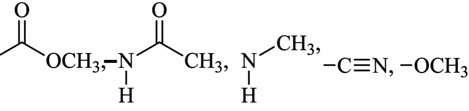
Correct Answer: 2
$$-COOCH_3$$ is a deactivating group because the carbonyl carbon attached directly to the aromatic ring withdraws electron density through both the $$-I$$ and $$-R$$ effects, making the ring less reactive toward electrophilic aromatic substitution.
$$-NHCOCH_3$$ is an activating group because the nitrogen atom attached directly to the ring can donate its lone pair into the aromatic system through resonance. Although the adjacent carbonyl group reduces this donation, the net effect remains activating.
$$-NHCH_3$$ is a strongly activating group because the nitrogen atom possesses a free lone pair that is readily delocalized into the aromatic ring, increasing its electron density through a strong $$+R$$ effect.
$$-C\equiv N$$ is a deactivating group because it strongly withdraws electron density from the aromatic ring through both the $$-I$$ and $$-R$$ effects, thereby decreasing the ring's reactivity.
$$-OCH_3$$ is an activating group because the oxygen atom donates electron density to the aromatic ring through resonance. Its $$+R$$ effect dominates over its $$-I$$ effect, resulting in overall activation.
Therefore, the deactivating groups are $$-COOCH_3$$ and $$-C\equiv N$$. Hence, the number of deactivating groups is $$2$$.
Was this solution helpful?
Create a FREE account and get:
_1.webp)

Educational materials for JEE preparation

Ask our AI anything

AI can make mistakes. Please verify important information.
AI can make mistakes. Please verify important information.
